
Installation #
Click here (Windows) / here (MacOS) to download the MTR Broker Management application first.
The Manager application is installed, updated and started from the MTR Broker Management application.
Log in to Manager application via MTR Broker Management application #
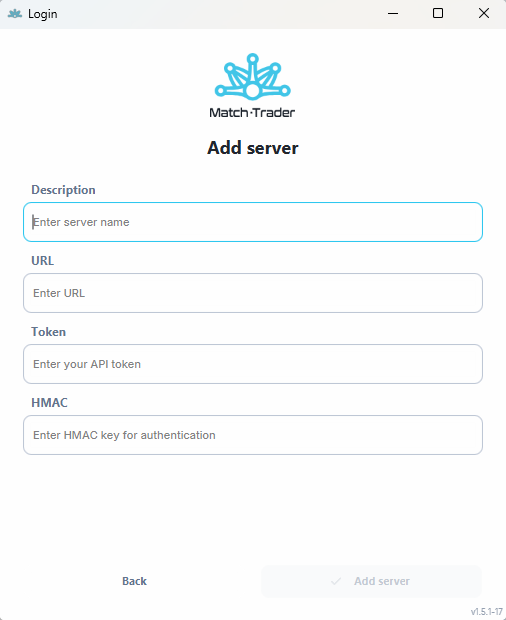
- In the Description field, give your server a name.
- In the Server field, type the server address. The server address is always provided by Match-Trade Technologies.
- In the Token and HMac fields, type the credentials of your manager account that we have provided you with.
- If you click Add server, your token and HMac are stored on your computer and used for future logins to the applications.
The token and HMac of your manager account are generated in the Admin application, on the Manager App Access tab of the account in Special Accounts. If you do not have them, ask Match-Trade Broker Support for help.
Network Reliability indicator #
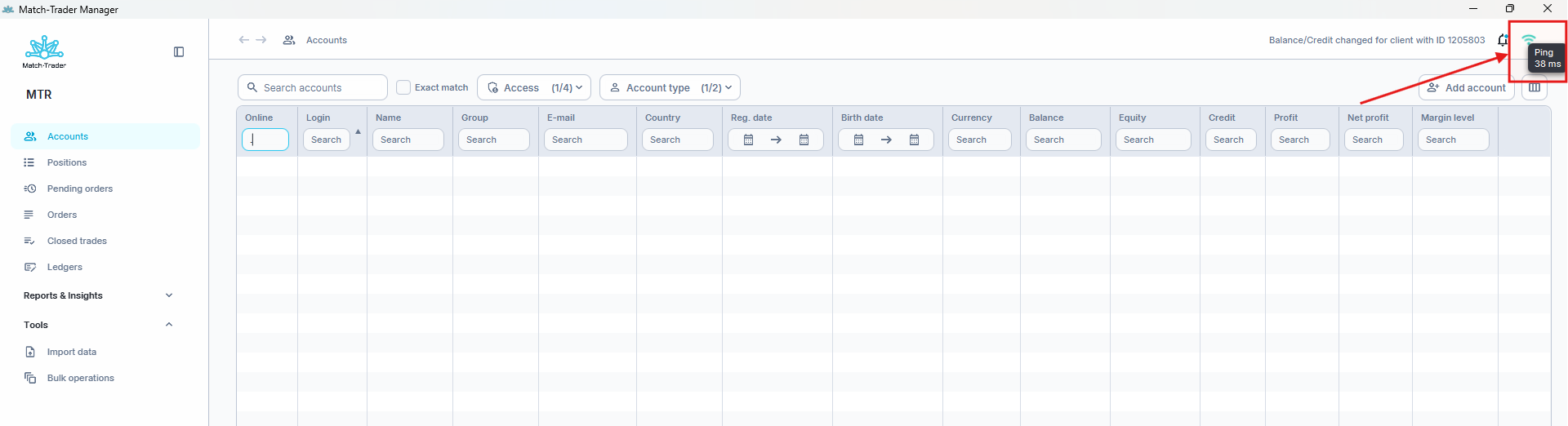
The Manager application shows a Network Reliability indicator – a Wi-Fi icon in the top-right corner of the window. Its state reflects the current latency (ping) between the application and the server, as well as any automatic reconnection attempts. Click the icon to see the current ping.
- Green – ping below 100 ms; the connection is healthy.
- Yellow (one grey bar) – ping between 100 ms and 300 ms; noticeable latency.
- Red (two grey bars) – ping above 300 ms, or the connection is degraded.
When the connection is lost, the application tries to reconnect for up to 30 seconds. During that time the icon reflects the retry state, so you can tell at a glance whether you are dealing with temporary latency or a real disconnection. If the connection cannot be restored in that time, you are logged out and a message tells you that the connection was lost.
Main window #
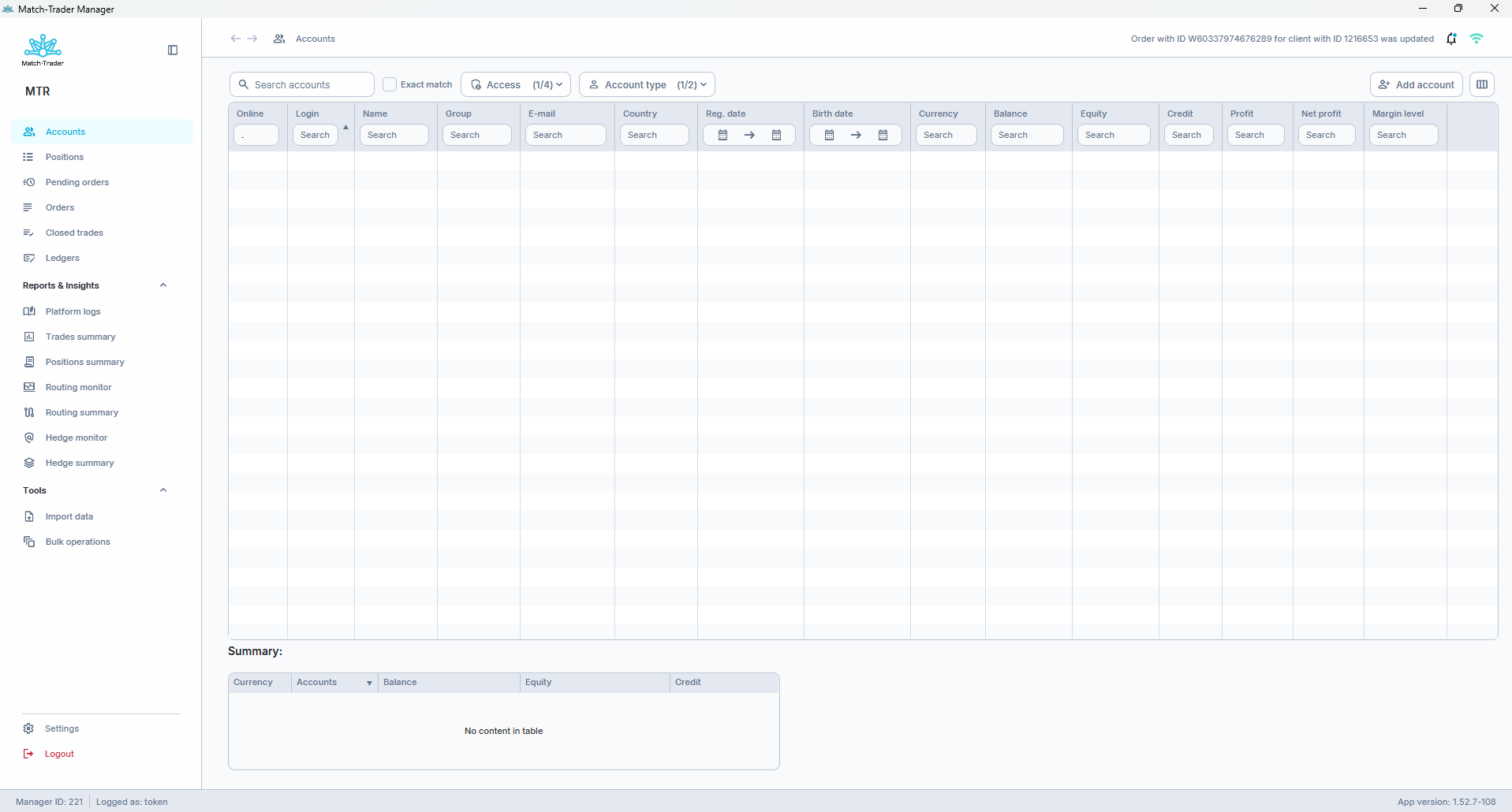
After you log in, the main window opens on the Accounts tab. It is divided into four areas: the menu on the left, the top bar, the working area in the middle and the status bar at the bottom.
Navigation #
- Menu – the tabs on the left: Accounts, Positions, Pending orders, Orders, Closed trades and Ledgers, followed by two sections that expand when you click them, Reports & Insights and Tools. Settings and Logout are at the bottom. Above the menu you can see the name of the environment you are connected to, together with a button that collapses the menu when you need more room for a wide table.
- Top bar – the back and forward arrows and the path to the current view, for example Accounts / Account: name (login). On the right you see the most recent notification, for example about a new order or a balance change on an account, followed by the bell icon, which opens the list of recent notifications, and the Network Reliability indicator.
- Status bar – your Manager ID and the token you are logged in with on the left, and the version of the application on the right.
Working with tables #
Most tabs show data in tables that work the same way:
- Search field – at the top left, filters the rows by the text you type, for example a login, name, e-mail address or group.
- Exact match – when ticked, only exact matches are shown. For example, when you search for US100, only US100 is displayed, not US100cash.
- Filters – drop-down lists such as Side, Access or Account type. The numbers next to the name show how many options are selected, for example (2/2).
- Column filters – each column has its own Search field below its name. Date columns have a from–to range with a calendar, and in number columns you can also use >, <, >= and <=, for example >1000.
- Sorting – click a column name to sort the table by that column.
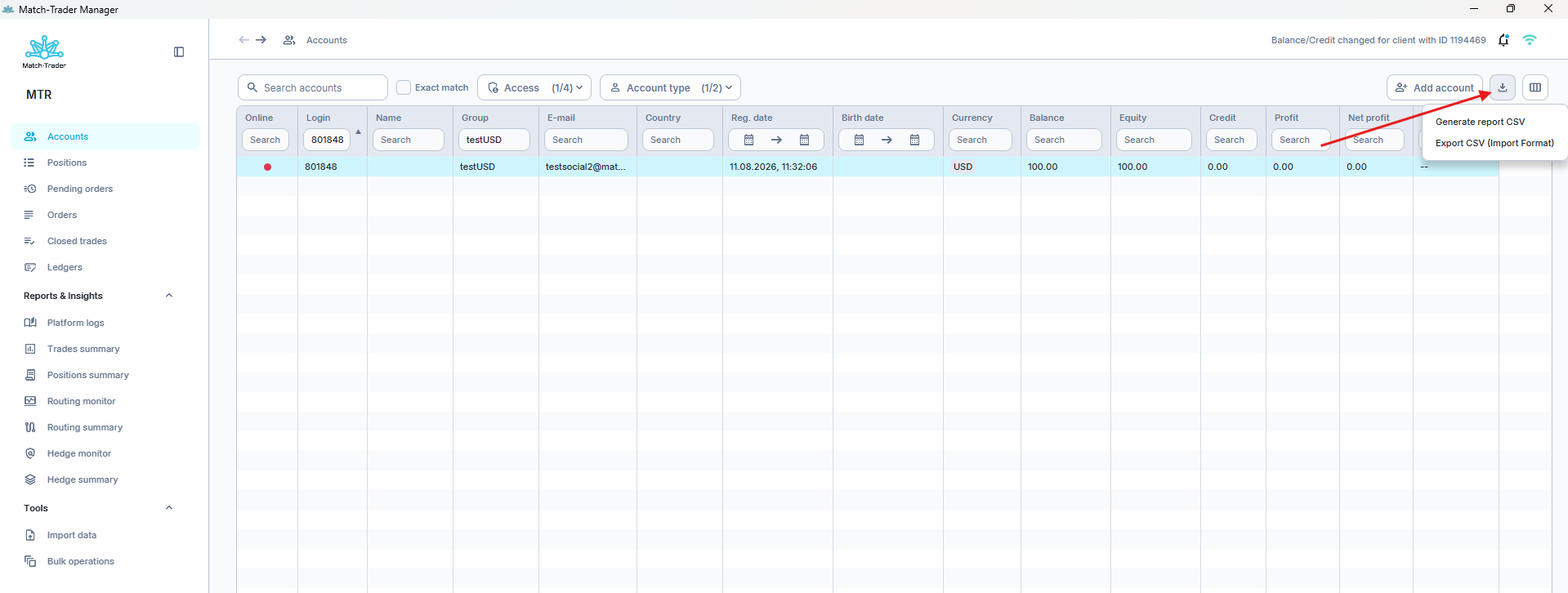
- Generate report (download icon) – saves the table to a CSV file. In the main tabs, the file contains the columns currently displayed and follows the filters and sorting you have applied. In the Accounts, Positions and Closed trades tabs, you can also save the data in Import format – the format accepted by Import data in Tools – so that the file can be imported again without any changes, for example when moving data between environments. In Closed trades, this option is available once data has been loaded with Get/Filter data.
- Columns (column icon) – chooses which columns are displayed. Default view restores the standard set of columns, Custom view switches to your own set and Save as custom view saves the current selection as your own set. Select all ticks every column.
- Summary – below the table, totals for the rows currently displayed, usually shown per currency.
The Accounts, Positions and Pending orders tabs are updated live: new accounts, positions and orders, and any changes to them, appear without refreshing. Profits on open positions are recalculated at the interval set in Settings.
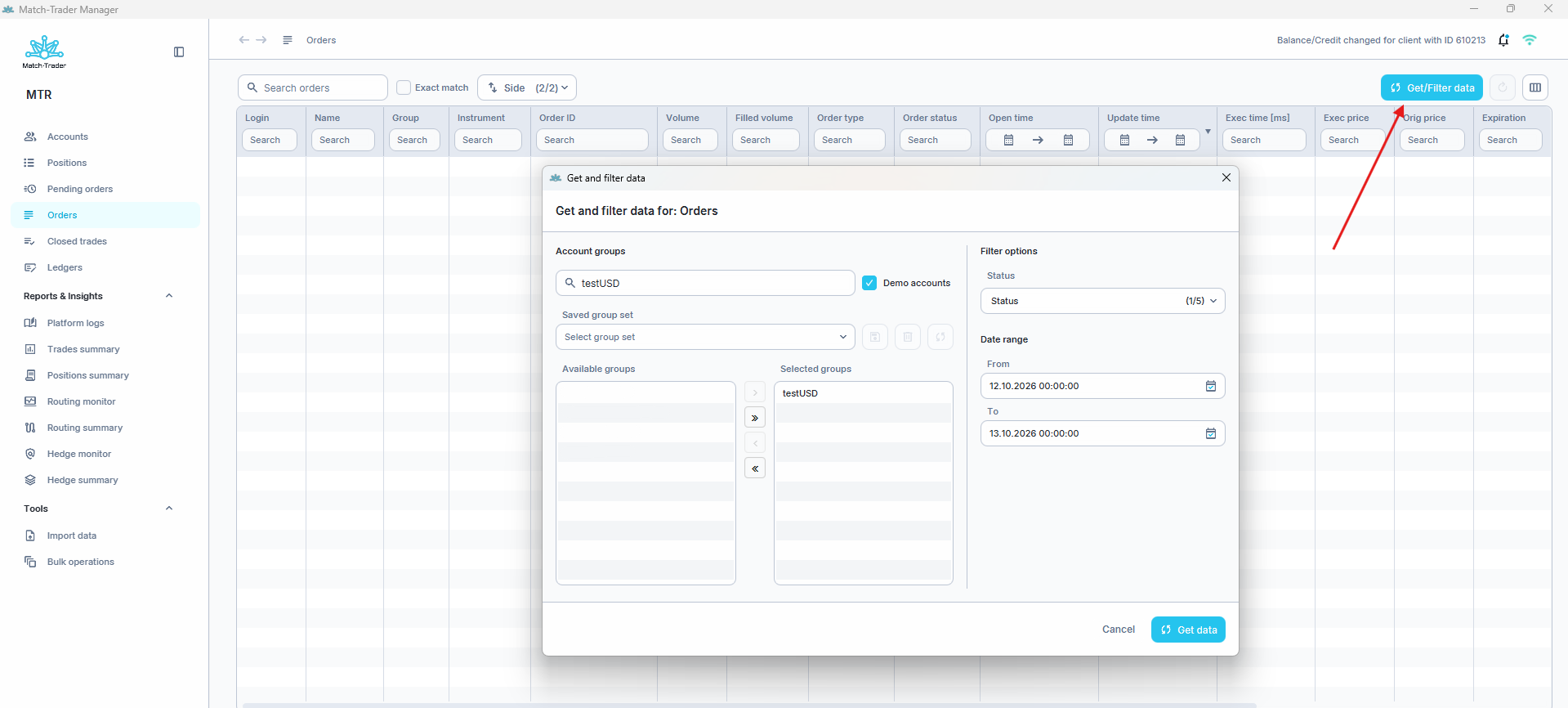
Get/Filter data. Tabs with historical data – Orders, Closed trades, Ledgers, Trades summary, Positions summary, Routing summary, Hedge summary and Bulk operations – are empty when you open them. Click Get/Filter data to choose what to load. The Get and filter data window contains:
- Account groups – type in Search for groups to find a group. Tick Demo accounts to include demo accounts.
- Saved group set – a saved selection of groups, so you do not have to pick the same groups every time. The buttons next to the list save the current selection as a set, delete the selected set and update it with the current selection.
- Available groups and Selected groups – the arrow buttons between the lists move the highlighted groups, or all groups, from one list to the other.
- Date range – the From and To date and time, in tabs that show data for a period.
- Filter options – additional filters offered by some tabs, for example the order Status in Orders.
- Get data loads the data; Cancel closes the window without loading anything.
Large amounts of data are loaded in parts, and the rows appear in the table as they arrive. If loading takes too long, you can cancel it – the table then shows only the part loaded so far.
Access rights #
What you can see and do in the Manager application depends on the rights and the client groups assigned to your manager account. Both are set by your administrator in the Admin application, in Special Accounts. You only see accounts from the groups assigned to you, and options you have no right to are either not shown or greyed out.
Some rights allow an action, others make a whole tab visible:
- Deposits and Withdrawals – depositing funds to trading accounts and withdrawing funds from them.
- Add Account – the Add account button in the Accounts tab.
- Modify Account – changing account details.
- Delete Account – deleting trading accounts.
- Trading – opening positions and placing orders on a client’s behalf in the Trading subtab.
- Position Edit – editing open positions, for example their open price, TP/SL, volume or swap, and removing positions.
- Edit Historical Data – changing closed trades, that is Reopen positions and Refund closed trades.
- Reports – generating reports from the Manager application.
- Routing Monitor, LP Routing Summary, Hedge Monitor and Hedge Summary – make the matching tabs visible in Reports & Insights; LP Routing Summary shows the Routing summary tab.
- Modify Hedge LP Volume – changing the hedge volume from the Hedge monitor.
- Personal Data – viewing clients’ personal data. Without it, for example, the Email column in Platform logs is hidden.
- Account Rules – the Account Rules subtab in the account details window.
White Label and Full-server License. The Manager application is the same whatever your license – the differences between manager accounts come only from the rights assigned to them. White Label manager accounts are not given the right to edit historical data, so closed trades cannot be reopened or refunded from them. Depending on the rights granted, some other options may also be missing, for example adding accounts, editing open positions, the Routing summary tab or the Account Rules subtab.
Changes you make are recorded – on the account itself, in Account history, and in the Audit Log of the Admin application.
Accounts tab #
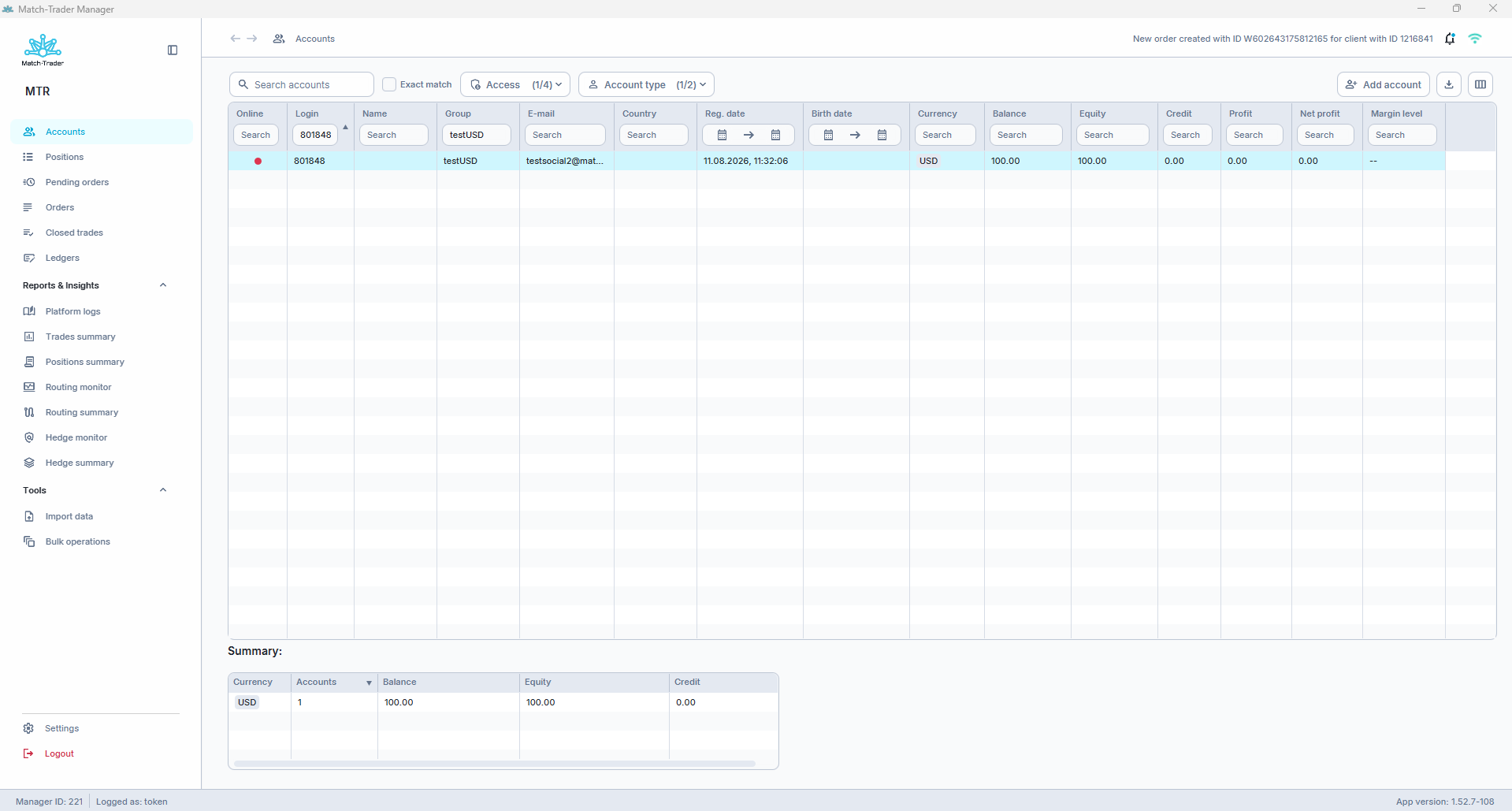
The Accounts tab lists the trading accounts from the groups assigned to you.
Accounts list #
Columns in the default view:
- Online – a green dot when the client is logged in to the platform, a red dot when not; a client counts as online when they have been active on the platform within the last 5 minutes.
- Login – the trading account number.
- Name – the client’s name.
- Group – the group the account belongs to.
- E-mail – the client’s e-mail address.
- Country – the client’s country.
- Reg. date – the date the account was registered.
- Currency – the currency of the trading account.
- Balance – the balance of the trading account.
- Equity – the equity of the trading account.
- Credit – the credit assigned to the trading account.
- Profit – the profit on open positions, including swaps and commissions.
- Net profit – the profit on open positions, without swaps and commissions.
- Margin level – the margin level of the trading account, colored according to the thresholds in Settings.
The column selector adds more columns:
- Last online – when the client was last logged in.
- Retail – ticked for accounts with Retail switched on (see Account Data).
- Company – the company the account belongs to, taken from its group.
- Phone, Address, Zip code, City and State – the client’s contact details.
- Leverage – the Leverage % setting of the account.
- Gross balance – the balance excluding swaps and commissions on open positions.
- Margin – the funds blocked to keep the open positions.
- Free margin – the funds still available for opening new positions.
- Remarks – notes about the client.
- Agent ID – the login of the agent account.
- Original account type – whether the account was created as a real or a demo account. It is set when the account is created and cannot be changed.
- Access right – the access right of the account (see Account Data).
Above the table:
- Search accounts – filters accounts by login, name, e-mail address or group.
- Exact match – shows exact matches only.
- Access – shows accounts with the selected access rights:
- Full access – accounts with full access rights.
- Close only – accounts that can only close positions.
- Trading disabled – accounts without trading rights.
- Login & trading disabled – blocked accounts: the client cannot log in or trade, and is logged out from all devices.
- Account type:
- Real accounts – shows real accounts.
- Demo accounts – shows demo accounts.
- Add account – opens the form for creating a new trading account, described in Adding an account below.
- Generate report (download icon) – saves the displayed accounts to a CSV file, or in Import format, ready to be imported with Import data (see Working with tables).
- Columns (column icon) – chooses the columns to display.
Below the table, the Summary shows the number of accounts and their total balance, equity and credit for each currency.
Double-click an account to open its details window, described in Account Information view.
Adding an account #
Add account opens the New account form. Fields marked with an asterisk are required, and Create account becomes available once they are filled in.
Important: an account created here is not connected to your CRM, so it will not work on its own – for example, the client cannot log in to the platform with it. After creating the account, import it into the CRM.
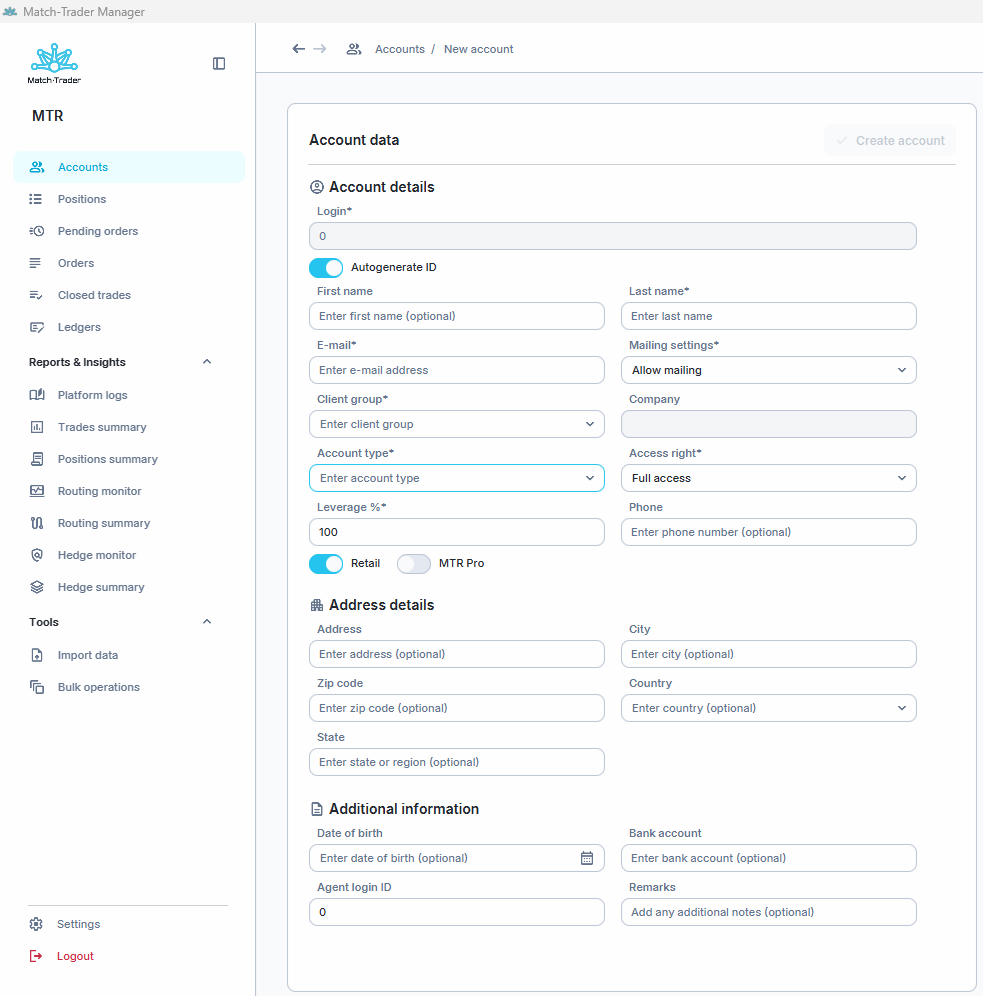
Account details:
- Login – the trading account number. With Autogenerate ID switched on, the system assigns the next free number and the field is greyed out; switch it off to enter the number yourself. Automatic numbering has to be enabled for your system – if it is not, you get an error message and need to enter the login yourself.
- First name – the client’s first name (optional).
- Last name – the client’s last name.
- E-mail – the client’s e-mail address.
- Mailing settings – Allow mailing or Block mailing, that is, whether the system sends e-mails to this account.
- Client group – the group the account is created in.
- Company – filled in automatically from the group; it cannot be edited.
- Account type – REAL or DEMO. It cannot be changed after the account is created.
- Access right – Full access by default; the options are described in Account Data.
- Leverage % – 100 by default; see Account Data for how it works.
- Phone – the client’s phone number (optional).
- Retail – decides whether positions net each other (see Account Data). It cannot be changed after the account is created, so set it with care.
- MTR Pro – gives the client the extended view of the Match-Trader platform.
Address details – Address, City, Zip code, Country and State, all optional.
Additional information – Date of birth, Bank account, Agent login ID and Remarks, all optional.
Account operations #
Right-click an account to open a menu with five operations:
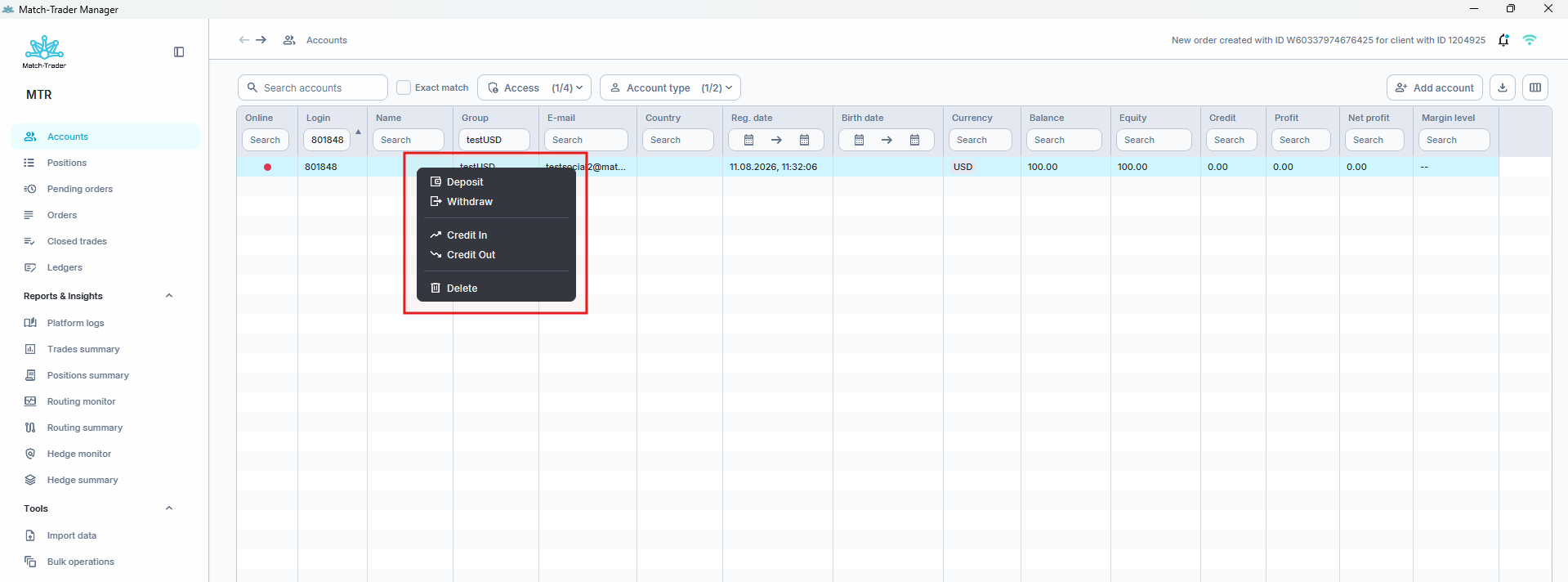
- Deposit / Withdraw – deposit funds to the account or withdraw them. The Deposit funds / Withdraw funds window shows the Login, Balance and Avail margin (available margin) of the account. Enter the Amount, choose the Type and optionally add a Comment, then click Deposit funds or Withdraw. The type describes the purpose of the operation – for example BANK, CRYPTO, BONUS IN OUT, CORRECTION or INTERNAL TRANSFER – and is shown in the Additional type column in Ledgers.
- Credit In / Credit Out – assign credit to the account or remove it. Enter the amount and optionally a comment. Credit allows an account to have a negative balance. For example, if an account has a balance of $100 and a credit of $100 and loses $200, the balance becomes -$100, while the credit remains $100.
- Delete – deletes the account. This is only possible when the account has no open positions, no balance and no credit.
Account Information view #
Double-click an account in the Accounts tab to open its details window. The header shows the client’s name and login, with a dot showing whether the client is online (green) or not (red).
The window is divided into subtabs, described in the sections below. Subtabs that list data have their own search field, filters, download icon and column selector, with a Summary below the table, as described in Working with tables.
In this window the download icon offers two options: Generate report saves the table to a CSV file with all its columns, including the hidden ones, and Account statement creates a statement of the account’s activity. In the statement window you choose the data to include – positions, pending orders, orders, closed trades and ledgers, including the ledger types – the date range and the file type: HTML for a complete statement, or CSV for one type of data.
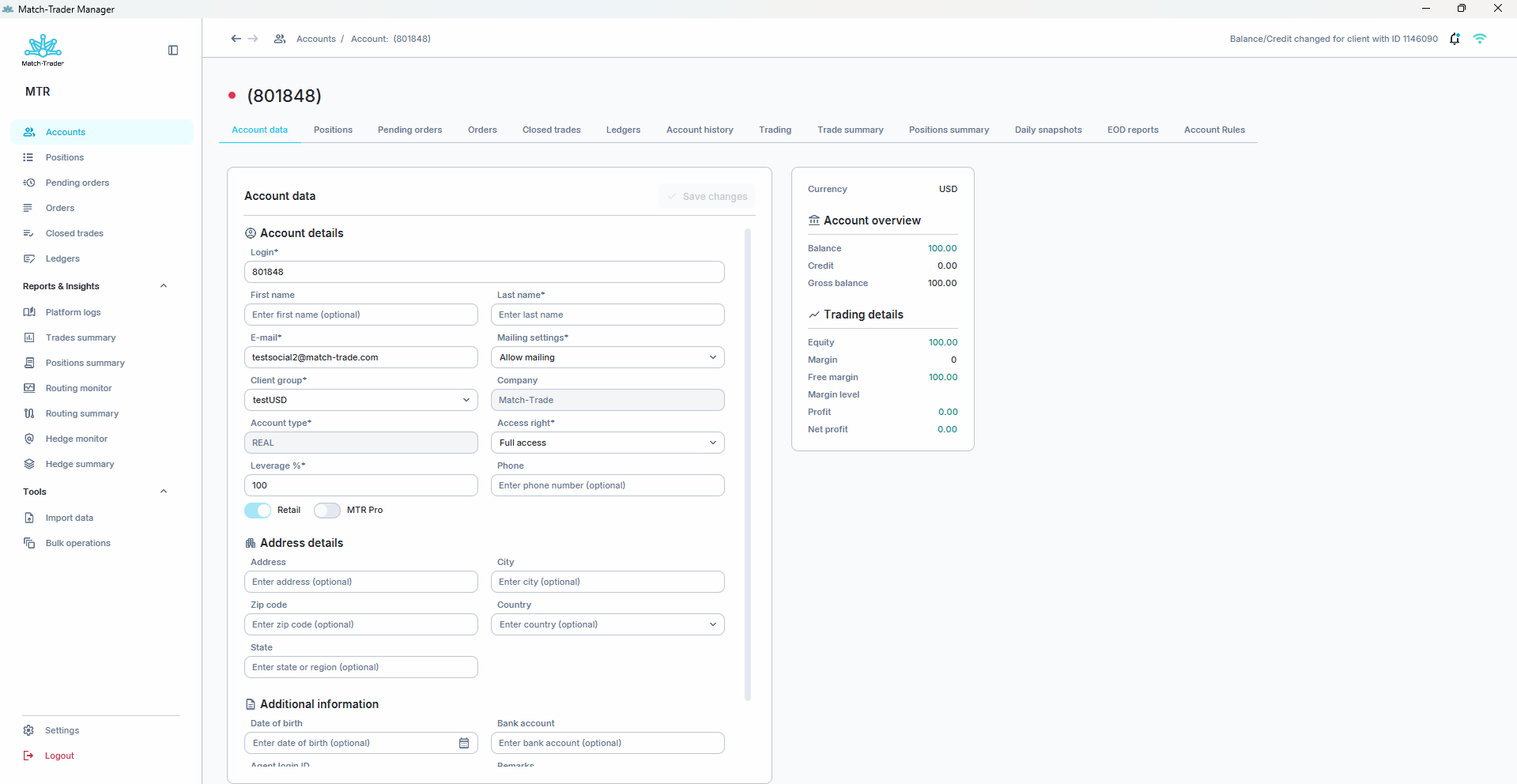
Account Data #
Account Data holds the details of the account. Change the fields you need and click Save changes – this requires the Modify Account right.
Account details:
- Login – the trading account number, which cannot be changed after the account is created.
- First name – the client’s first name.
- Last name – the client’s last name.
- E-mail – the client’s e-mail address.
- Mailing settings – whether mailing is allowed or blocked for the account.
- Client group – the group the account belongs to. You can move the account to another group, but only to one with the same currency. Changing the group does not change the Leverage % of the account.
- Company – the company the account belongs to, taken from its group; read-only.
- Account type – whether the account is real or demo; read-only.
- Access right – what the client is allowed to do:
- Full access – the client can log in and trade without restrictions.
- Login & trading disabled – the client cannot log in or trade, and is logged out from all devices.
- Trading disabled – the client can log in but cannot trade.
- Close only – the client cannot open new positions, only close the existing ones.
- Locked close only – a combination of Trading disabled and Close only, used mainly as a temporary state for prop trading accounts.
- Leverage % – the percentage of the leverage set on the group. If the leverage on the group is 1:100, setting this option to 50 changes the leverage for this account to 50% of it, that is 1:50.
- Phone – the client’s phone number.
- Retail – switched on, positions do not net each other, so opposite positions on the same instrument stay open side by side. Switched off, positions net each other – opening an opposite position closes the original one. It is set when the account is created and cannot be changed here.
- MTR Pro – gives the client the extended view of the Match-Trader platform, including the order book.
Close only and Locked close only are available for accounts with Retail switched on. Other accounts can have Full access, Login & trading disabled or Trading disabled.
Address details:
- Address – the client’s street address.
- City – the city where the client lives.
- Zip code – the client’s zip code.
- Country – the client’s country.
- State – the client’s state or region.
Additional information:
- Date of birth – the client’s date of birth.
- Bank account – the client’s bank account.
- Agent login ID – the login of the account where agent (IB) commissions are booked. Every account that agent commission is calculated for should have the agent’s login filled in.
- Remarks – notes about the client.
- Registration date – when the account was registered; read-only.
To the right of the form you see the Account overview – Currency, Balance, Credit and Gross balance – and the Trading details – Equity, Margin, Free margin, Margin level, Profit and Net profit.
Positions #
Positions shows all open positions on the account. Above the table: Search positions, the Side filter (BUY, SELL), the download icon and the column selector.
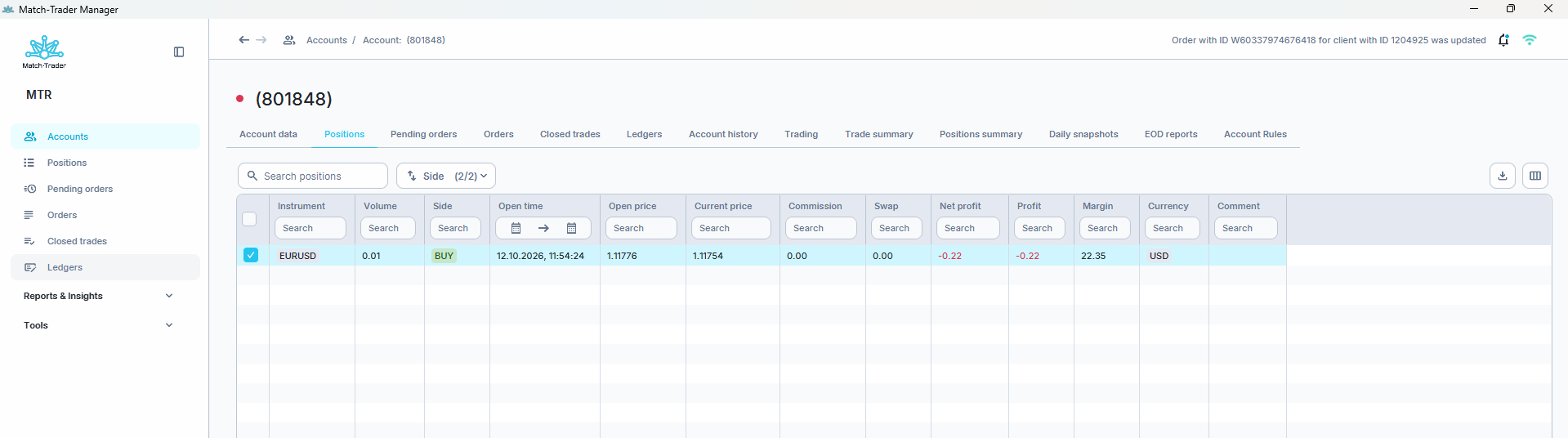
Columns in the default view:
- Instrument – the instrument the position is open on.
- Volume – the volume of the position, shown in lots by default.
- Side – the market side of the position, BUY or SELL.
- Open time – when the position was opened.
- Open price – the price at which the position was opened.
- Current price – the current market price of the instrument.
- Commission – the commission charged for opening the position.
- Swap – the swap accumulated on the position.
- Net profit – the profit without swaps and commissions.
- Profit – the profit including swaps and commissions.
- Margin – the margin blocked for the position.
- Currency – the currency of the trading account.
- Comment – an optional remark.
The column selector adds Login, Name, Group, Instrument alias, Order ID (the ID of the position), UID (the unique ID of each part of a position, useful when several parts share one Order ID), Value in USD (the value of the position in US dollars), Take profit, Stop loss, Trailing distance and Original account ID (for orders coming from another platform, the ID of the client account there).
The Summary shows, per currency, the number of positions and their total Volume, Value in USD, Commission, Swap, Net profit and Profit.
Right-click a position to open a menu with the following operations:
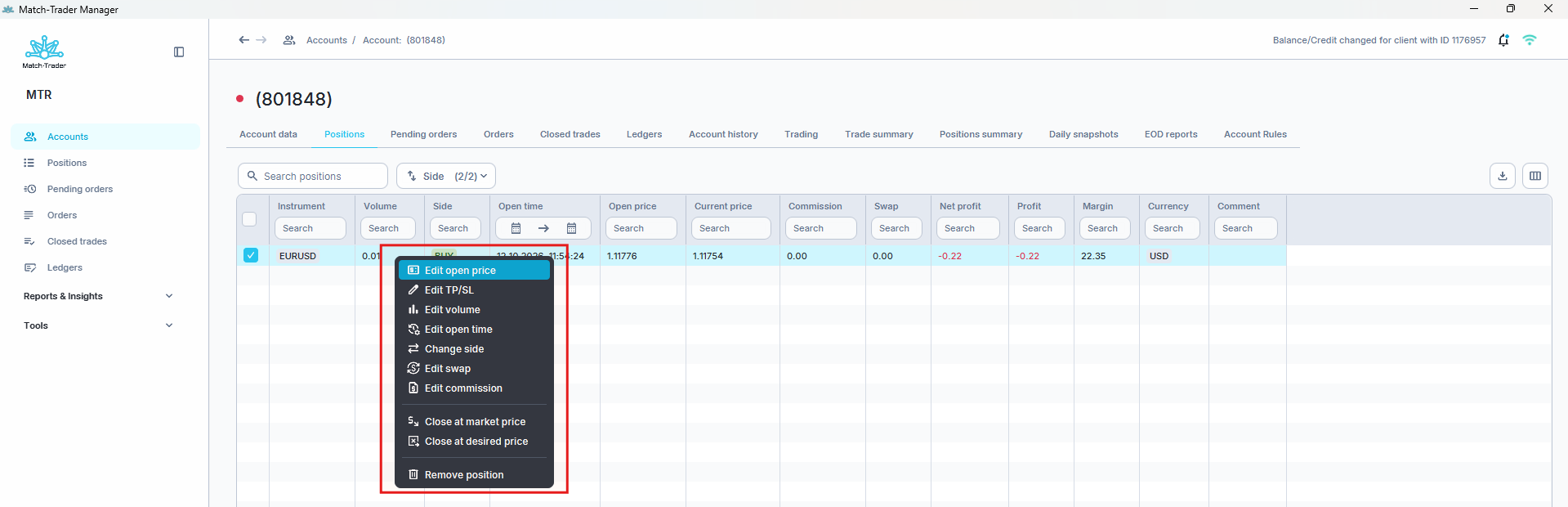
- Edit open price – changes the open price of the position.
- Edit TP/SL – sets, changes or removes the take profit and stop loss. For a single position the window shows the current values, or 0 when a level is not set; for several selected positions the fields are empty, and the values you enter are applied to all of them. Enter 0 to remove a level.
- Edit volume – changes the size of the position, in lots. When you reduce the volume, the volume of the position’s TP/SL is reduced accordingly.
- Edit open time – changes the time the position was opened.
- Change side – changes the market side of the position.
- Edit swap – changes the swap accumulated on the position.
- Edit commission – changes the commission charged for opening the position.
- Close at market price – closes the position at the current market price.
- Close at desired price* – closes the position at a price you specify.
- Remove position – removes the position from the system.
* To close positions at a desired price, filter the list so that only one instrument is visible. Positions on different instruments cannot be closed at a desired price at the same time.
You can select several positions – tick the boxes on the left – and apply an operation to all of them at once. Some operations can only be applied together to positions on the same instrument or on the same side. All operations except closing require the Position Edit right; without it, the menu shows only Close at market price and Close at desired price.
Pending Orders #
Pending Orders lists the pending orders of the account, such as buy limit, sell limit, buy stop or sell stop orders. Above the table: Search pending orders, the Side filter, the download icon and the column selector.
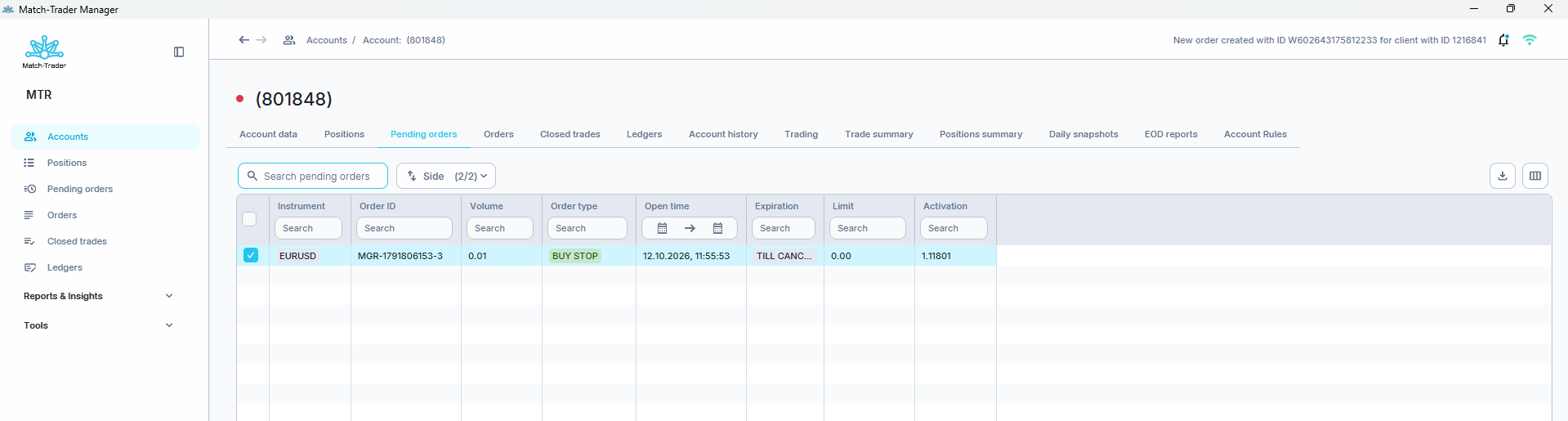
Columns in the default view:
- Instrument – the instrument of the order.
- Order ID – the ID of the order.
- Volume – the volume of the order.
- Order type – the type of the order, for example BUY LIMIT or SELL STOP.
- Open time – when the order was created.
- Expiration – how long the order stays valid, for example until it is cancelled.
- Limit – the activation price of a limit order.
- Activation – the activation price of a stop order.
The Summary shows the number of pending orders and their total volume.
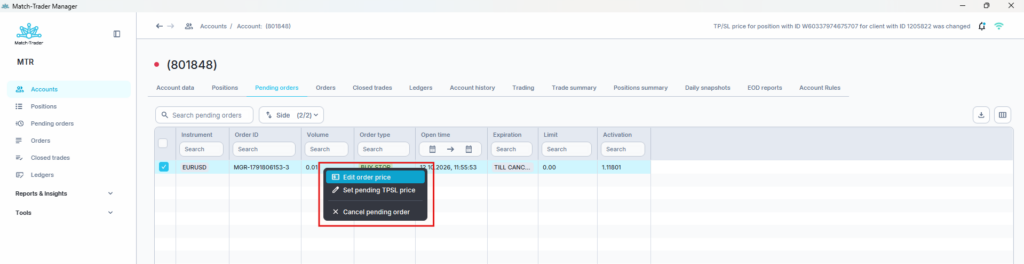
Right-click an order – or several selected orders – to open the menu:
- Edit order price – changes the price of the pending order.
- Set pending TPSL price – sets the take profit and stop loss of the pending order.
- Cancel pending order – cancels the order.
Orders #
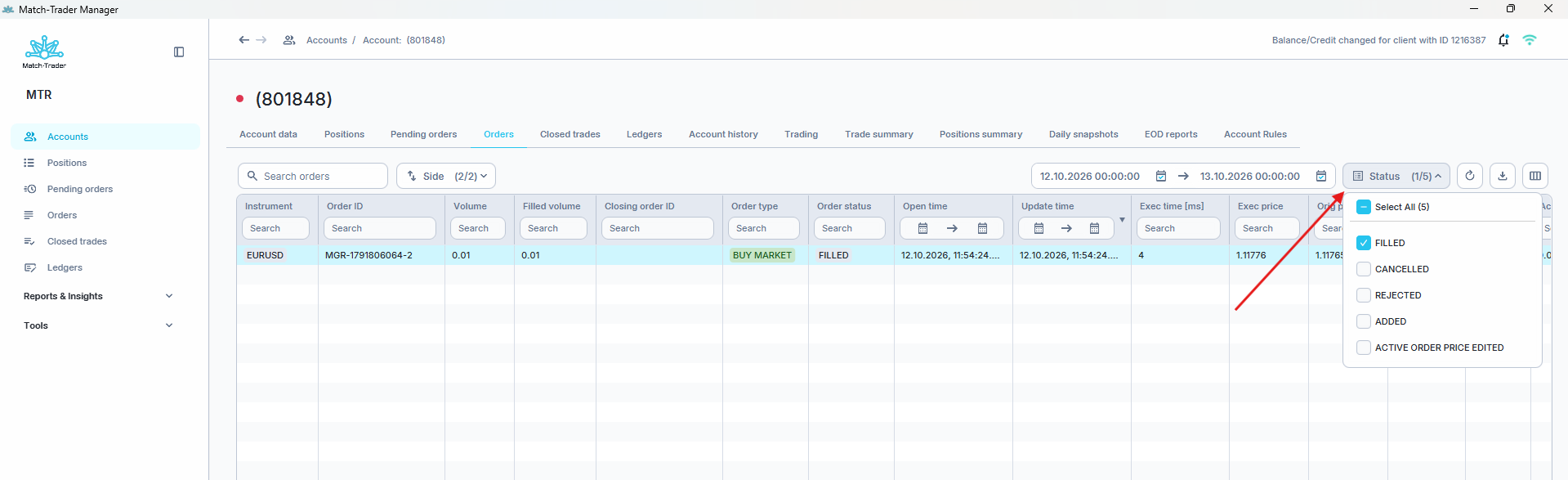
Orders shows the history of all orders of the account in the selected date range. Set the range at the top and click refresh to load the data. Next to the date range, the Status filter selects the order statuses you are interested in:
- FILLED – the order was executed.
- CANCELLED – the order was cancelled.
- REJECTED – the order was rejected by the system.
- ADDED – an order was added, for example a stop loss.
- ACTIVE ORDER PRICE EDITED – the price of an existing order was changed.
Columns in this window:
- Instrument – the instrument of the order.
- Order ID – the ID of the order.
- Volume – the volume of the order.
- Filled volume – the volume that was filled, useful for partially filled orders.
- Closing order ID – for an order that closes a position, the ID of that position.
- Order type – the type of the order.
- Order status – the status of the order.
- Open time – when the order was created.
- Update time – when the order was last updated.
- Exec time [ms] – the execution time of a filled order, in milliseconds.
- Exec price – the price at which the order was filled.
- Orig price – the execution price without group markups.
- Expiration – the time parameter of the order:
- FoK (fill or kill) – the order is executed immediately and in full, or not at all.
- IoC (immediate or cancel) – the order is executed immediately and as fully as possible.
- Limit – the activation price of a limit order.
- Activation – the activation price of a stop order.
- Comment – an optional remark.
- System comment – a remark added by the system.
The Summary shows the number of Orders, their Volume and Filled volume, the Market exec time [ms], the Value in USD and the VWAP slippage – the volume-weighted average slippage. Orders filled without slippage are not counted in it, and a dash is shown when there are none.
Closed Trades #
Closed Trades shows the trades closed on the account in the selected date range. Above the table: Search closed trades, the Side filter, the date range, refresh, the download icon and the column selector.
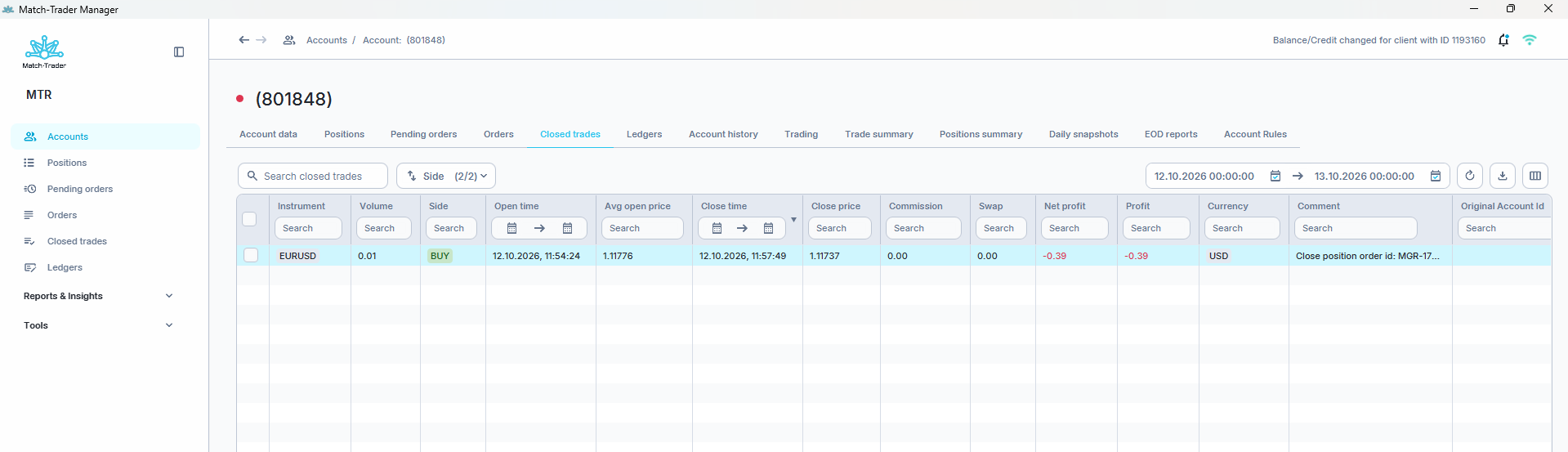
Columns in the default view:
- Instrument – the instrument the trade was made on.
- Volume – the volume of the closed trade.
- Side – the market side of the trade.
- Open time – when the trade was opened.
- Avg open price – the average open price.
- Close time – when the trade was closed.
- Close price – the price at which the trade was closed.
- Commission – the commission charged for the trade.
- Swap – the swap accumulated on the trade.
- Net profit – the profit without swaps and commissions.
- Profit – the profit including swaps and commissions.
- Currency – the currency of the trading account.
- Comment – a remark, for example the ID of the order that closed the position.
- Original Account Id – for orders coming from another platform, the ID of the client account there.
More columns, such as Value in USD, can be added with the column selector. The Summary shows, per currency, the number of trades and their total Volume, Commission, Swap, Net profit and Profit, together with the Trade duration.
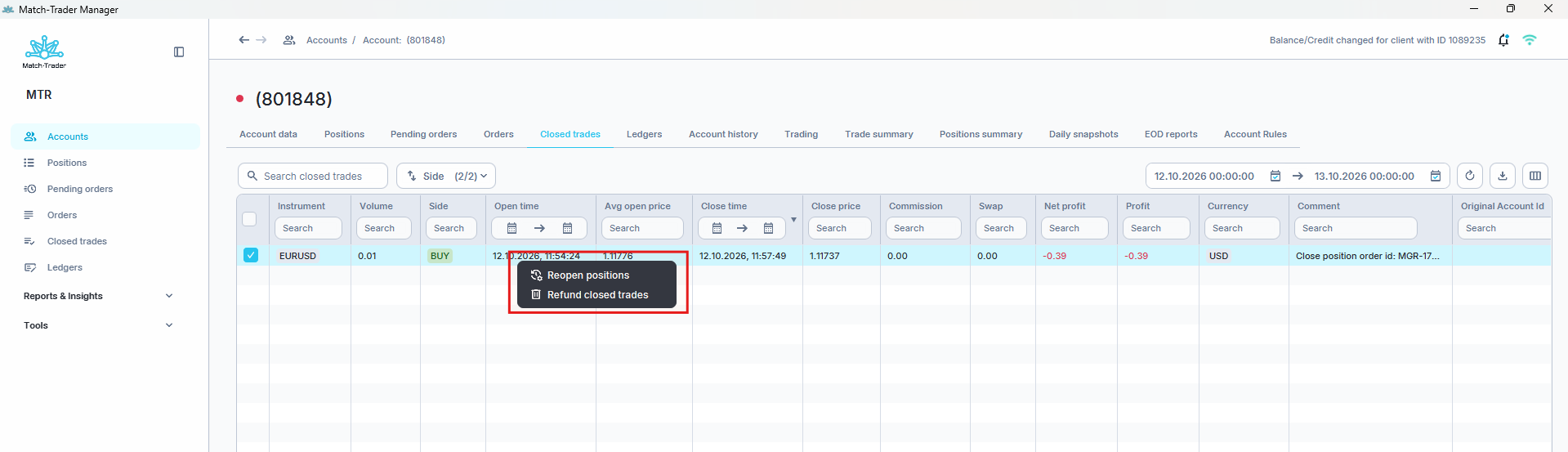
Right-click a trade – or several selected trades – to open the menu:
- Reopen positions – opens the closed trade again as a position with the same instrument, side, volume, open price, open time and swap, and removes it from the closed trades. The profit booked when the trade was closed is reversed, and commission is charged as for a newly opened position. The Order ID of the new position starts with RE-, and its comment shows which trade was reopened. Take profit and stop loss are not carried over. Reopening is available for retail accounts only, and the account needs enough free margin.
- Refund closed trades – the system treats the trade as if it had never happened: it is removed from the history and its profit is taken back from the account balance.
Note for White Label accounts: access to this subtab is limited. White Label manager accounts do not have the Edit Historical Data right, so the Reopen positions and Refund closed trades options are not available – closed trades can be viewed and exported, but not changed.
Ledgers #
Ledgers lists all cash operations on the account in the selected date range – deposits, withdrawals, credits in and out, swaps, closed positions, commissions and agent commissions. Above the table: Search ledgers, the date range, the Type filter (DEPOSIT, WITHDRAWAL, COMMISSION, SWAP, CLOSE POSITION, CREDIT IN, CREDIT OUT and AGENT COMMISSION), refresh, the download icon and the column selector.
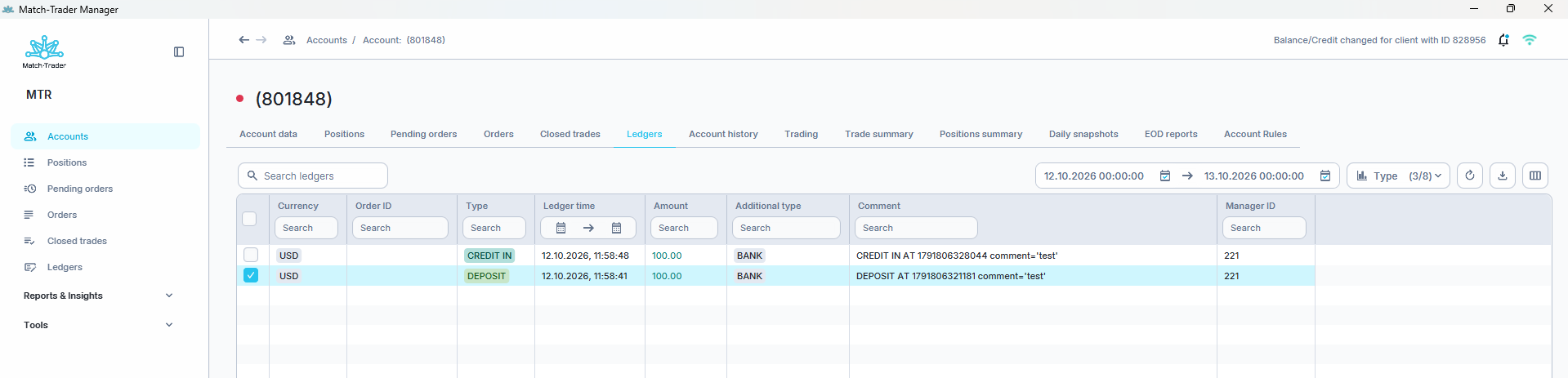
Columns in the default view:
- Currency – the currency of the operation.
- Order ID – for operations related to positions, the ID of the order.
- Type – the type of the operation.
- Ledger time – when the operation was booked.
- Amount – the amount in the currency of the account.
- Additional type – the type chosen for a deposit, withdrawal or credit operation, for example BANK.
- Comment – the comment of the operation.
- Manager ID – for operations made manually, for example a deposit, the ID of the manager who made it.
The column selector adds Name, Login, Group and Manager token name – the name of the token the manager was logged in with. The Summary shows, per currency, the number of ledgers and their total amount.
Right-click a ledger to edit its comment or additional type. Deposits, withdrawals, credits in and credits out can also be refunded – the operation is removed and the balance or credit of the account is corrected accordingly.
Account history #
Account history shows who changed what on the account, and when. Above the table: Search account history, the date range, refresh and the column selector.
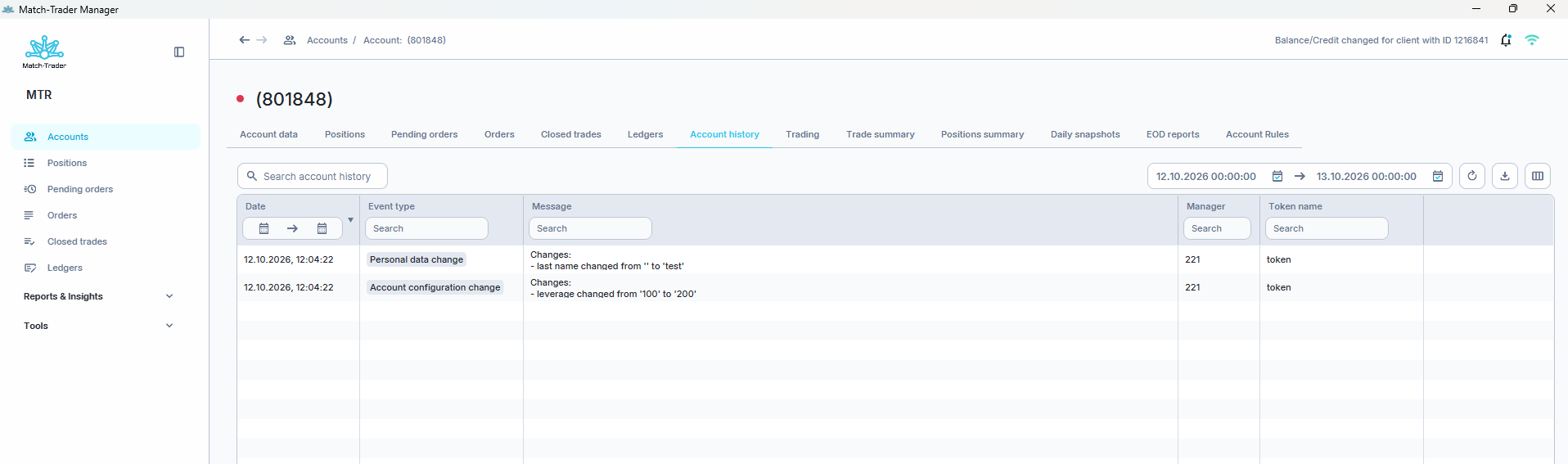
- Date – when the change was made.
- Event type – the action performed on the account.
- Message – a more detailed description of the action.
- Manager – the manager account the change was made from.
- Token name – the token the manager was logged in with when making the change.
Trading #
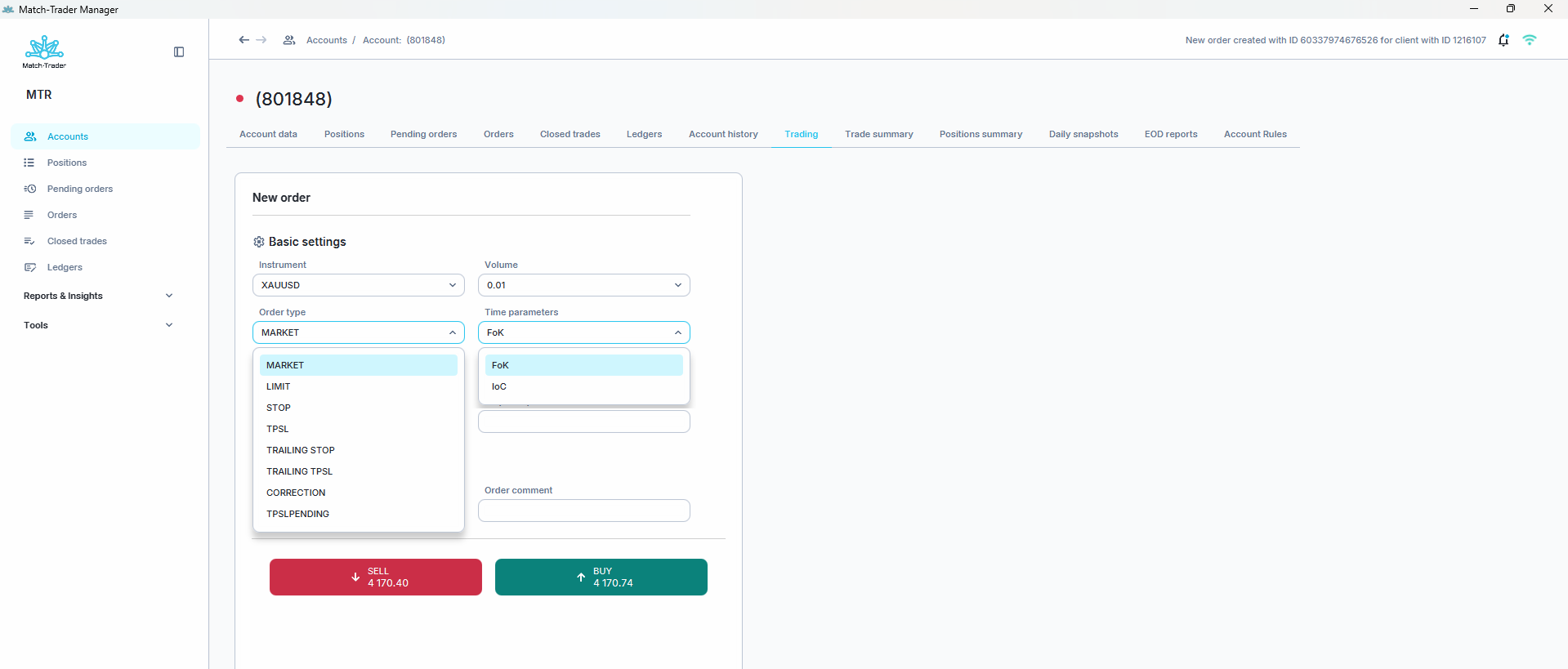
In the Trading subtab you can open a position or place an order on the client’s behalf. The New order form has three sections:
- Basic settings:
- Instrument – the instrument of the order.
- Volume – the volume of the order.
- Order type – MARKET, LIMIT, STOP, TPSL, TRAILING STOP, TRAILING TPSL, CORRECTION or TPSLPENDING. Depending on the type, additional price fields may appear, such as the limit or activation price.
- Time parameters – FoK (fill or kill) or IoC (immediate or cancel).
- Risk management:
- Take profit price – the take profit of the order.
- Stop loss price – the stop loss of the order.
- Advanced options:
- Closing order ID – the ID of an open position the order should close.
- Order comment – an optional remark.
Click SELL or BUY – the buttons show the current prices – to send the order. The subtab requires the Trading right.
Trade Summary #
Trade Summary shows trading statistics of the account in the selected date range, broken down by instrument. Above the table: the date range, refresh and the column selector.
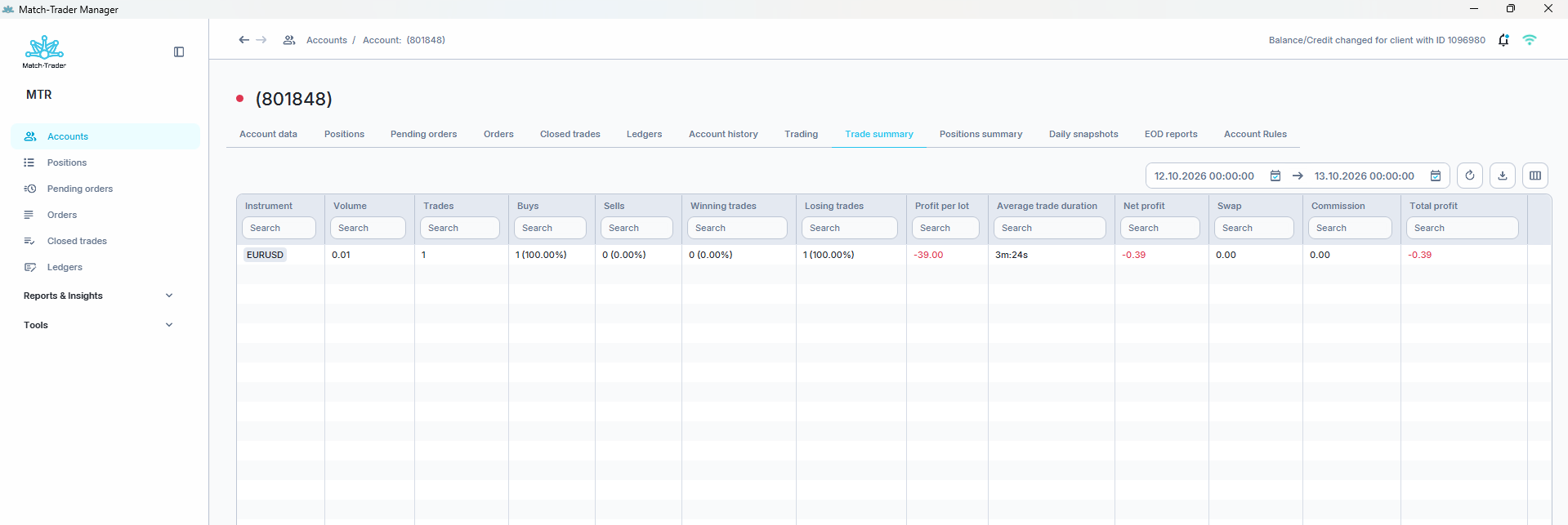
- Instrument – the instrument the trades were made on.
- Volume – the total volume traded on the instrument.
- Trades – the number of trades.
- Buys – the number of buy trades.
- Sells – the number of sell trades.
- Winning trades – the number and percentage of profitable trades.
- Losing trades – the number and percentage of losing trades.
- Profit per lot – the average profit per lot.
- Average trade duration – how long the trades lasted on average.
- Net profit – the profit without swaps and commissions.
- Swap – the swap of all trades.
- Commission – the commission charged.
- Total profit – the profit of the trades, including swaps and commissions.
The Summary adds up the values for all instruments.
Positions Summary #
Positions Summary shows the open positions of the account grouped by instrument. Above the table: refresh, the download icon and the column selector.
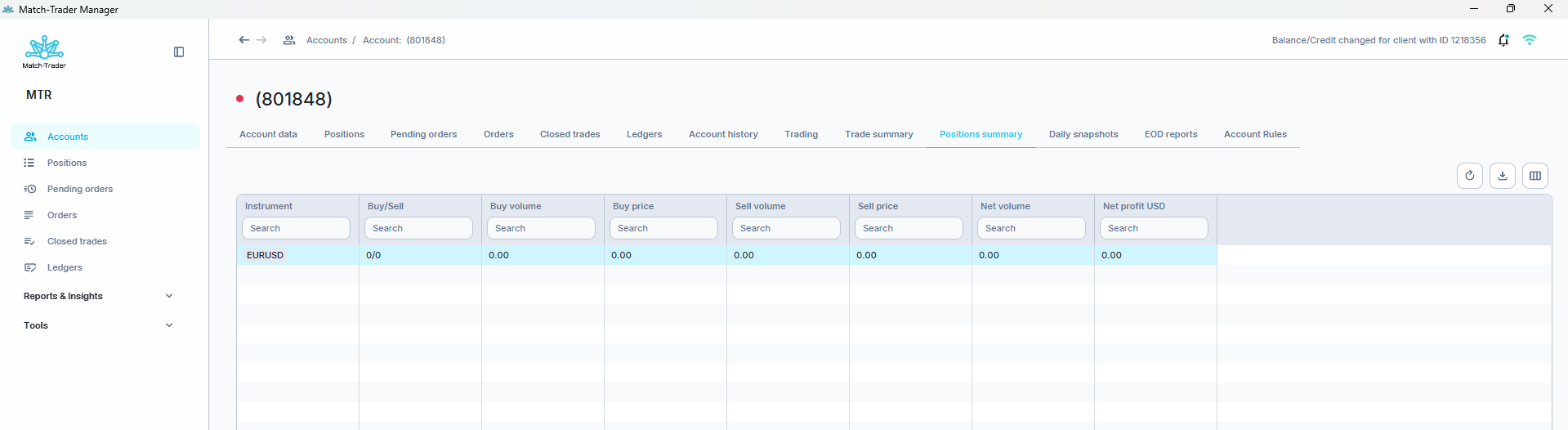
- Instrument – the instrument of the positions.
- Buy/Sell – the number of buy and sell positions, for example 2/0.
- Buy volume – the volume of buy positions.
- Buy price – the average open price of buy positions.
- Sell volume – the volume of sell positions.
- Sell price – the average open price of sell positions.
- Net volume – the net volume of all positions.
- Net profit USD – the net profit of the positions, in US dollars.
The Summary shows the totals: Buy/Sell, Buy volume, Sell volume, Net volume, Hedged volume, Total net volume, Value in USD, Swap, Commission, Net profit USD, Hedged profit and Total net profit USD. The hedged values concern positions in groups with Coverage Mode switched on, and the total net values are what remains after deducting them.
Daily Snapshots #
Daily Snapshots shows the state of the account recorded once a day, when the daily snapshot is taken. Choose the date range at the top.
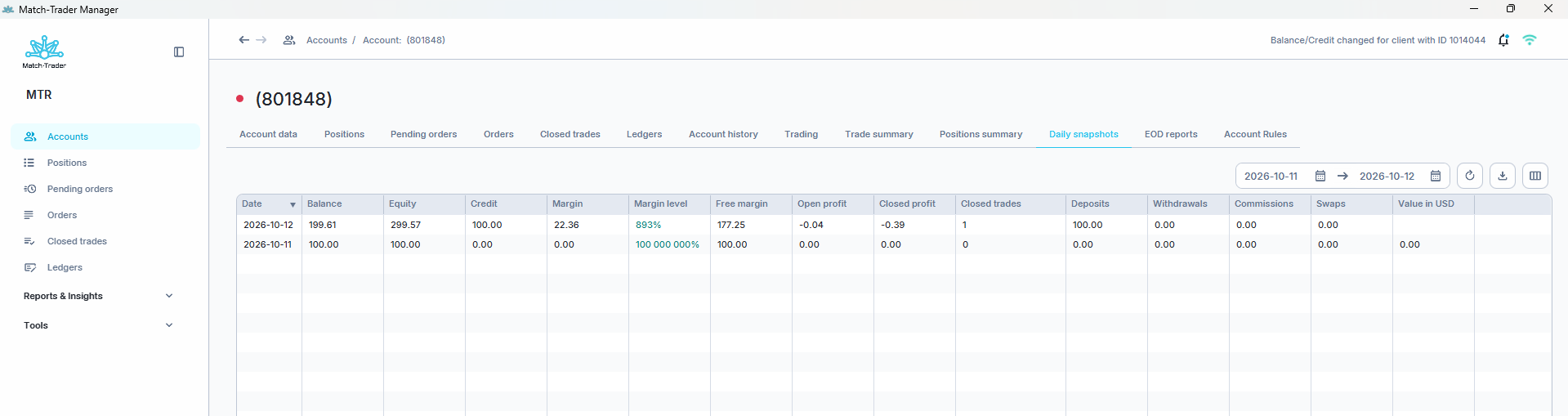
- Date – the date of the snapshot.
- Balance – the account balance at the time of the snapshot.
- Equity – the account equity at the time of the snapshot.
- Credit – the account credit at the time of the snapshot.
- Margin – the account margin at the time of the snapshot.
- Margin level – the margin level at the time of the snapshot.
- Free margin – the free margin at the time of the snapshot.
- Open profit – the profit on open positions at the time of the snapshot.
- Closed profit – the profit on trades closed during the day.
- Closed trades – the number of trades closed during the day.
- Deposits – the deposits made during the day.
- Withdrawals – the withdrawals made during the day.
- Commissions – the commissions charged during the day.
- Swaps – the swaps charged during the day.
- Value in USD – the value of the open positions in US dollars at the time of the snapshot.
EOD Reports #
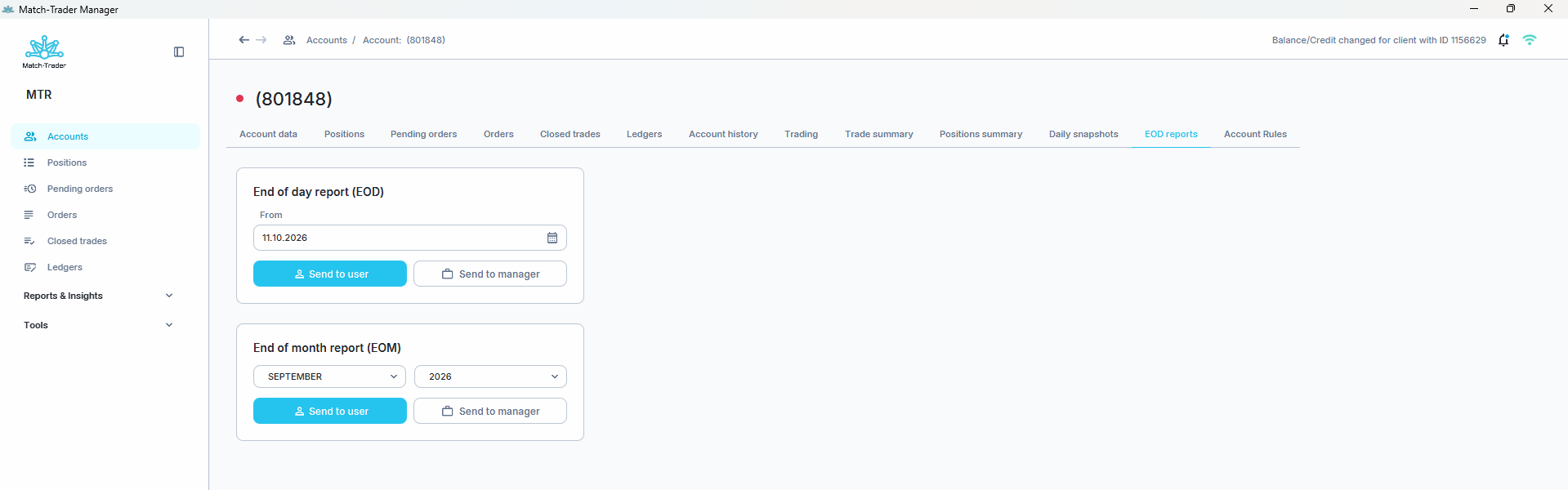
EOD Reports lets you send the end-of-day or end-of-month report of the account by e-mail – to the client, at the e-mail address of the account, or to the manager, at the e-mail address of your manager account.
- End of day report (EOD) – choose the day in From, then click Send to user or Send to manager.
- End of month report (EOM) – choose the month and the year, then click Send to user or Send to manager.
Account Rules #
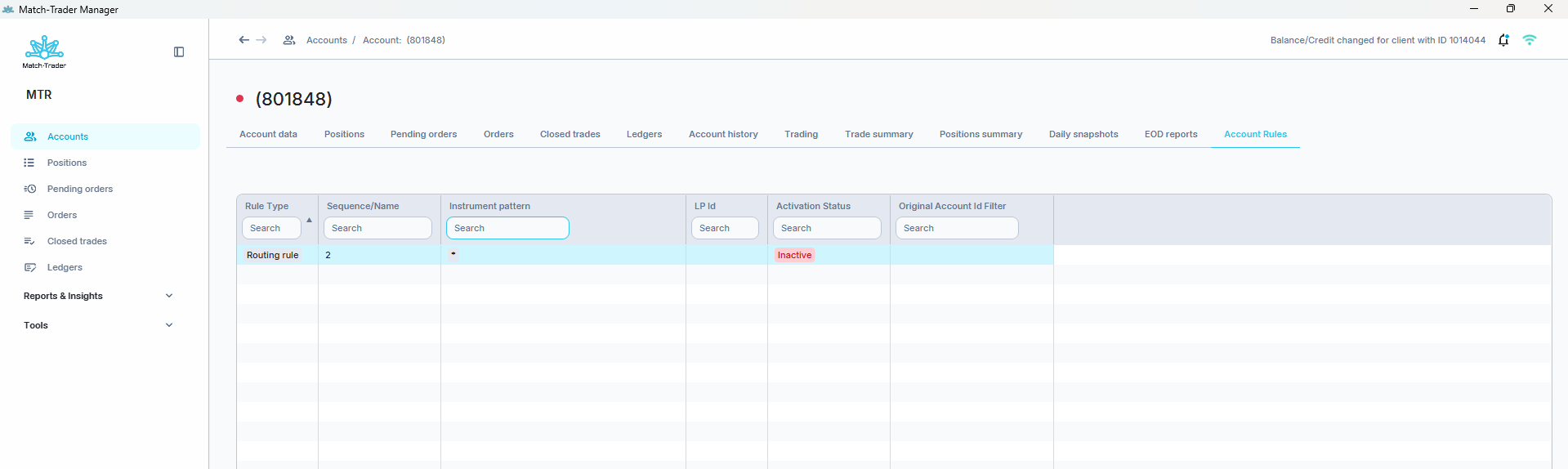
Account Rules lists the routing, hedge and abuse rules that apply to the account. The list is loaded each time you open the subtab, so changes made to the rules in the Admin application are visible as soon as you open it again.
A rule is listed when the account matches it: a routing rule when the group of the account matches the rule’s group pattern, an abuse rule when the account is set as the rule’s abuse account, and a hedge rule when the rule’s client filter covers the group or the login of the account. All matching rules are shown, even though not all of them have to be applied – for example, a given order is routed by one routing rule only.
- Rule Type – Routing, Hedge or Abuse.
- Sequence/Name – the sequence number of a routing or abuse rule, or the name of a hedge rule.
- Instrument pattern – the instruments the rule applies to.
- LP Id – the liquidity provider the rule sends orders to.
- Activation Status – whether the rule is active; hedge rules are always shown as active.
- Original Account Id Filter – the original account IDs the rule is limited to; always empty for routing rules.
The subtab requires the Account Rules right; without it, it is greyed out.
Positions tab #
The Positions tab lists the open positions of all accounts in the groups assigned to you. The list is updated live.
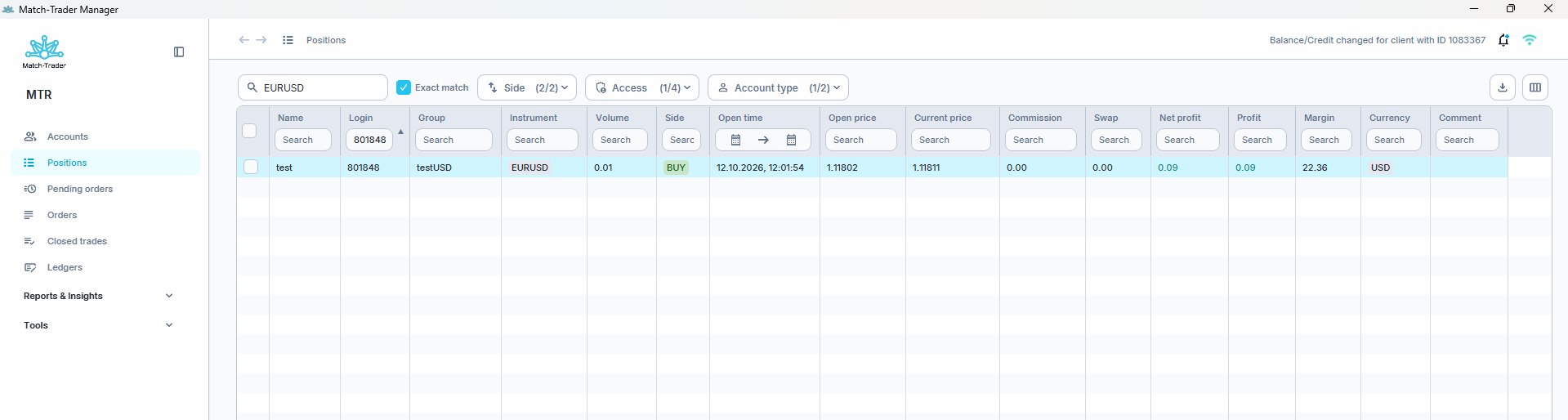
Columns in the default view:
- Name – the client’s name.
- Login – the trading account number.
- Group – the group of the account.
- Instrument – the instrument the position is open on.
- Volume – the volume of the position, shown in lots by default.
- Side – the market side of the position.
- Open time – when the position was opened.
- Open price – the price at which the position was opened.
- Current price – the current market price of the instrument.
- Commission – the commission charged for opening the position.
- Swap – the swap accumulated on the position.
- Net profit – the profit without swaps and commissions.
- Profit – the profit including swaps and commissions.
- Margin – the margin blocked for the position.
- Currency – the currency of the trading account.
- Comment – an optional remark.
More columns, for example Order ID, Take profit or Stop loss, can be added with the column selector.
Above the table: Search positions, Exact match and three filters:
- Side – BUY or SELL.
- Access – the access rights of the accounts: Full access, Close only, Trading disabled and Login & trading disabled.
- Account type – real or demo accounts.
On the right are the download icon – which can also save the positions in Import format – and the column selector. The Summary shows, per currency, the number of positions and their total Volume, Value in USD, Commission, Swap, Net profit and Profit.
Right-click a position – or several selected positions – to open the menu:
- Close at market price – the positions are closed at the market price.
- Close at desired price – the positions are closed at a price you specify. Important: to close positions at a desired price, filter the list so that only one instrument is visible. Positions on different instruments cannot be closed at a desired price at the same time.
Other operations on positions, such as editing the open price or TP/SL, are available in the Positions subtab of the account details window.
Pending orders tab #
The Pending orders tab lists the pending orders of all accounts in the groups assigned to you. The list is updated live.
Columns in the default view:
- Name – the client’s name.
- Login – the trading account number.
- Group – the group of the account.
- Instrument – the instrument of the order.
- Order ID – the ID of the order.
- Volume – the volume of the order.
- Order type – the type of the order.
- Open time – when the order was created.
- Expiration – how long the order stays valid.
- Limit – the activation price of a limit order.
- Activation – the activation price of a stop order.
Above the table: Search pending orders, Exact match and the Side, Access and Account type filters, which work as in the Positions tab. The Summary shows the number of pending orders and their total volume.
To cancel orders, select them, right-click and choose Cancel pending order.
Orders tab #
The Orders tab shows the history of the orders of all accounts in the groups assigned to you. It is empty when you open it: click Get/Filter data, choose the groups, the order Status and the date range, and click Get data (see Working with tables).
Columns in the default view:
- Login – the trading account number.
- Name – the client’s name.
- Group – the group of the account.
- Instrument – the instrument of the order.
- Order ID – the ID of the order.
- Volume – the volume of the order.
- Filled volume – the volume that was filled, useful for partially filled orders.
- Order type – the type of the order.
- Order status – the status of the order.
- Open time – when the order was created.
- Update time – when the order was last updated.
- Exec time [ms] – the execution time of a filled order, in milliseconds.
- Exec price – the price at which the order was filled.
- Orig price – the execution price without group markups.
- Expiration – the time parameter of the order.
- Limit – the activation price of a limit order.
- Activation – the activation price of a stop order.
- Comment – an optional remark.
- System comment – a remark added by the system.
Above the table: Search orders, Exact match, the Side filter, Get/Filter data, refresh, the download icon and the column selector. The Summary shows the same totals as the Orders subtab of the account details window.
Closed trades tab #
The Closed trades tab shows the closed trades of all accounts in the groups assigned to you. Click Get/Filter data to choose the groups and the date range and load the data.
Columns in the default view:
- Login – the trading account number.
- Name – the client’s name.
- Group – the group of the account.
- Instrument – the instrument the trade was made on.
- Volume – the volume of the closed trade.
- Side – the market side of the trade.
- Open time – when the trade was opened.
- Avg open price – the average open price.
- Close time – when the trade was closed.
- Close price – the price at which the trade was closed.
- Commission – the commission charged for the trade.
- Swap – the swap accumulated on the trade.
- Net profit – the profit without swaps and commissions.
- Profit – the profit including swaps and commissions.
- Currency – the currency of the trading account.
- Comment – a remark, for example the ID of the order that closed the position.
Above the table: Search closed trades, Exact match, the Side filter, Get/Filter data, refresh, the download icon – which can also save the trades in Import format – and the column selector. The Summary shows, per currency, the number of trades and their totals.
Right-click a trade – or several selected trades – to use Reopen positions or Refund closed trades. Both work as described in the Closed Trades subtab of the account details window.
Note for White Label accounts: access to this tab is limited. White Label manager accounts do not have the Edit Historical Data right, so closed trades can be viewed and exported, but not reopened or refunded.
Ledgers tab #
The Ledgers tab lists the cash operations of all accounts in the groups assigned to you – deposits, withdrawals, credits in and out, swaps, closed positions, commissions and agent commissions. Click Get/Filter data to choose the groups and the date range and load the data.
Columns in the default view:
- Login – the trading account number.
- Name – the client’s name.
- Group – the group of the account.
- Currency – the currency of the operation.
- Order ID – for operations related to positions, the ID of the order.
- Type – the type of the operation.
- Ledger time – when the operation was booked.
- Amount – the amount in the currency of the account.
- Additional type – the type chosen for a deposit, withdrawal or credit operation, for example BANK.
- Comment – the comment of the operation.
- Manager ID – for operations made manually, for example a deposit, the ID of the manager who made it.
Above the table: Search ledgers, Exact match, Get/Filter data, refresh, the download icon and the column selector. The Summary shows, per currency, the number of ledgers and their total amount. The right-click options are the same as in the Ledgers subtab of the account details window.
Reports & Insights #
Click Reports & Insights in the menu to expand seven tabs, each described below. Which of them you see depends on your rights.
Platform logs #
Platform logs lists the actions and events recorded on the trading platform. Use it to monitor activity, review clients’ actions and look into issues reported by clients. Logs are kept for 3 months; older entries are removed automatically.
Above the table: Search logs, which searches the log entries, a question-mark icon with help on searching, the date range, Get data, the download icon and the column selector. Set the date range and click Get data to load the logs.
Columns in the default view:
- Date – when the event happened.
- Type – the category of the log, for example Application or System.
- Trading account – the account the event concerns.
- Email – the e-mail address of the user who performed the action. It is hidden if you do not have the Personal Data right.
- Level – the log level, for example Info or Error.
- Event – the name of the action, for example Open Position or Close Position.
- ID – the ID of the position or order the event concerns.
- Instrument – the instrument involved.
- Volume – the volume of the trade or order.
- Open price and Close price – the open and close price.
- Side – buy or sell.
- Old SL price and Old TP price – the stop loss and take profit before a change.
- New SL price and New TP price – the stop loss and take profit after a change.
- Old activation price – the activation price of a pending order before a change.
More columns can be added with the column selector, for example the IP address, device type, country, app type and version, or the user agent. Generate report saves the table to a CSV file and follows the current filters and sorting.
Trades Summary #
Trades Summary shows trading statistics for the groups and the date range you select. Choose Summary by client to see one row per trading account, or Summary by instrument to see one row per instrument, then click Get/Filter data.
Columns in the Summary by client view:
- Login – the trading account number.
- Name – the client’s name.
- Group – the group of the account.
- Volume – the total volume traded.
- Trades – the number of trades.
- Buys – the number of buy trades.
- Sells – the number of sell trades.
- Winning trades – the number and percentage of profitable trades.
- Losing trades – the number and percentage of losing trades.
- Profit per lot – the average profit per lot.
- Most profitable instrument – the instrument with the highest profit.
- Average trade duration – how long the trades lasted on average.
- Net profit – the profit without swaps and commissions.
- Swap – the swap of all trades.
- Commission – the commission charged.
- Total profit – the profit of all trades, including swaps and commissions.
The Summary adds up the values for all clients, including the number of Clients.
Positions Summary #
Positions Summary shows the open positions of the groups you select. Choose Summary by client or Summary by instrument, then click Get/Filter data.
Columns in the Summary by client view:
- Client – the trading account number.
- Name – the client’s name.
- Buy/Sell – the number of buy and sell positions.
- Buy volume – the volume of buy positions.
- Sell volume – the volume of sell positions.
- Net volume – the net volume of all positions.
- Net profit USD – the net profit of the positions, in US dollars.
The Summary shows the totals: Buy/Sell, Buy volume, Sell volume, Net volume, Value in USD, Swap, Commission and Net profit USD, together with Hedged volume and Hedged profit – the volume and profit of positions in groups with Coverage Mode switched on, that is your hedge positions – and Total net volume and Total net profit USD, the net values after deducting the hedged ones. When you are fully hedged, the total net volume is zero.
Routing Monitor #
Routing Monitor compares your clients’ exposure routed to each liquidity provider with the exposure on the provider’s side. Discrepancies are shown in red. Click Refresh to load the data; each provider row, for example LP: 111, can be expanded to show its instruments.
- Broker – the liquidity provider the trades are routed to.
- Instrument – the instrument.
- Time of occurrence – when the discrepancy appeared.
- Difference – the difference between the clients’ volume and the volume on the provider’s account.
- Clients volume – your clients’ net volume routed to the provider.
- LP volume – the volume on the provider’s account. For external providers it is shown as 0.
- Mirror Accounts Volume – the total volume of the mirror accounts set on the routing rules that lead to the provider.
- Mirror accounts – the IDs of those mirror accounts.
- Last modified – when the clients’ position was last changed.
- LP last modified – when the position on the provider’s account was last changed.
- Margin level (%) – the margin level of the provider’s account.
The clients’ volume is counted according to routing rules only – trades routed by abuse rules are not included. You see a provider only if you have access to the groups whose trades are routed to it. For internal providers, a discrepancy can be corrected with the Adjust option; it is not available for external providers.
To find out more about routing rules, see the Match-Trader Admin Application manual.
Routing summary #
Routing summary lists the orders routed to liquidity providers for the groups and the date range you select. Click Get/Filter data to load them.
- Instrument – the instrument of the order.
- Time – when the order was created.
- Fill ID – the ID of the fill of the routed order.
- Order ID – the ID of the client order that was routed.
- Client ID – the account that placed the order.
- Side – the side of the order.
- Volume – the volume of the routed order.
- LP status – the status of the order on the provider’s side.
- LP ID – the ID of the liquidity provider.
- LP order ID – the ID of the order on the provider’s side.
- Internal price – the execution price including markups.
- LP fill price – the price at which the provider filled the order.
- LP message – a remark from the provider’s system.
The Summary shows the number of orders and their total volume.
Hedge monitor #
Hedge monitor shows, for each hedge rule, whether the volume hedged with the liquidity provider matches what the rule expects. Discrepancies are shown in red. Click Refresh to load the data; a rule can be expanded to its instruments and, where the rule uses an original account filter, to the original accounts.
- Rule name – the name of the hedge rule.
- Instrument – the instrument.
- Original account – the original account the volume comes from.
- Coverage % – the percentage of the volume above the threshold that should be hedged.
- Clients volume – the clients’ net volume covered by the rule.
- Hedge threshold – the volume in lots above which the rule starts hedging.
- Expected LP volume – the volume that should be hedged: the clients’ volume above the threshold, multiplied by the coverage.
- LP volume – the volume actually hedged with the provider.
- Difference – the difference between the expected and the actual LP volume.
- Mirror account volume – the volume of the mirror account set on the rule.
Right-click a rule to open the menu:
- Adjust hedge on rule – sends an order to the liquidity provider to remove the discrepancy, so that the LP volume matches the expected volume.
- Set hedge LP volume – changes the LP volume recorded for the rule, for example when the position on the provider’s account was changed outside the system. You can specify the original account the change applies to.
You see only the rules whose groups and accounts you have access to. To find out more about hedge rules, see the Match-Trader Admin Application manual.
Hedge summary #
Hedge summary lists the hedge orders executed under hedge rules for the groups and the date range you select. Click Get/Filter data to load them.
- Timestamp – when the hedge order was made.
- Instrument – the instrument.
- Client ID – the account that placed the order that triggered the hedge.
- Hedge LP ID – the ID of the hedge liquidity provider.
- Fill ID – the ID of the fill of the hedge order.
- Source client order ID – the ID of the client order that triggered the hedge.
- Source order fill price – the price at which the client order was filled.
- Hedged order ID – the ID of the hedge order.
- Side – the side of the order.
- Volume – the volume of the order.
- Rule threshold – the volume in lots above which the rule hedges; 0.00 means that every position is hedged.
- Volume before order – the volume covered by the rule before the order.
- Volume after order – the volume covered by the rule after the order.
- LP exec report status – the status reported by the provider.
- LP fill price – the price at which the provider filled the hedge order.
- LP message – a remark from the provider, for example when the position could not be opened on the hedge account.
The Summary shows the number of hedge orders and their total volume.
Tools tab #
Click Tools in the menu to expand two tabs: Import data and Bulk operations.
Import data #
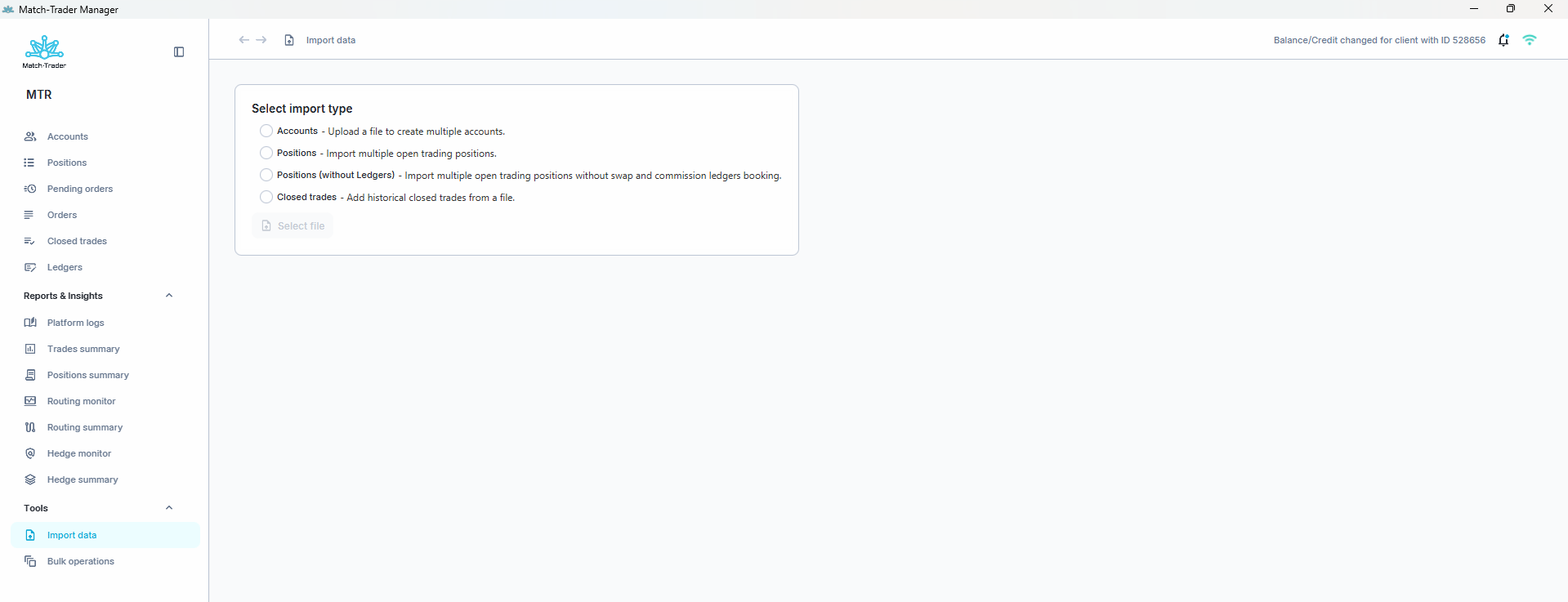
Import data creates accounts, positions or closed trades from a CSV file. Select the import type, click Select file and choose the file. A window then shows the progress of the import, and you can stop it if needed.
- Accounts – upload a file to create multiple accounts.
- Positions – import multiple open trading positions.
- Positions (without Ledgers) – import multiple open trading positions without booking swap and commission ledgers: the positions keep their swap and commission, but the account balance does not change.
- Closed trades – add historical closed trades from a file.
The file must be in the format expected for the selected import type. To get a file in this format, open the Accounts, Positions or Closed trades tab and save the data with Generate report in Import format (see Working with tables). Such a file can be imported without any changes, and you can also use it as a template for your own data. Imported accounts get the import date as their registration date, and imported positions get the time of the import as their open time.
Bulk operations #
Bulk operations lets you make the same change on many accounts at once. Click Get/Filter data, choose the groups and click Get data. Then select the accounts – tick the box to the left of each account, or the box in the header to select all accounts displayed – and right-click to choose the operation.
Columns in the default view:
- Account – the trading account number.
- Email – the client’s e-mail address.
- Name – the client’s name.
- Group – the group of the account.
- Balance – the account balance.
- Credit – the account credit.
- Access right – the access right of the account.
- Inactivity days – the number of days since the client last placed an order.
- Result – the result of the last operation on the account, for example an error message.
Reg. date, Mailing settings and MTR Pro can be added with the column selector.
Right-click the selected accounts to choose:
- Change group – moves the accounts to another group.
- Remove positions – removes all open positions.
- Remove balance – removes the balance of the accounts.
- Remove credit – removes the credit of the accounts.
- Change access rights – sets the access right: Full access, Login & trading disabled, Trading disabled, Close only or Locked close only.
- Change mailing settings – allows or blocks mailing.
- Change MTR Pro settings – switches MTR Pro on or off.
- Full account delete – deletes the trading accounts.
Operations you do not have the rights for are not shown in the menu.
Settings #
Settings, at the bottom of the menu, holds your preferences for the Manager application. Change what you need and click Save changes.
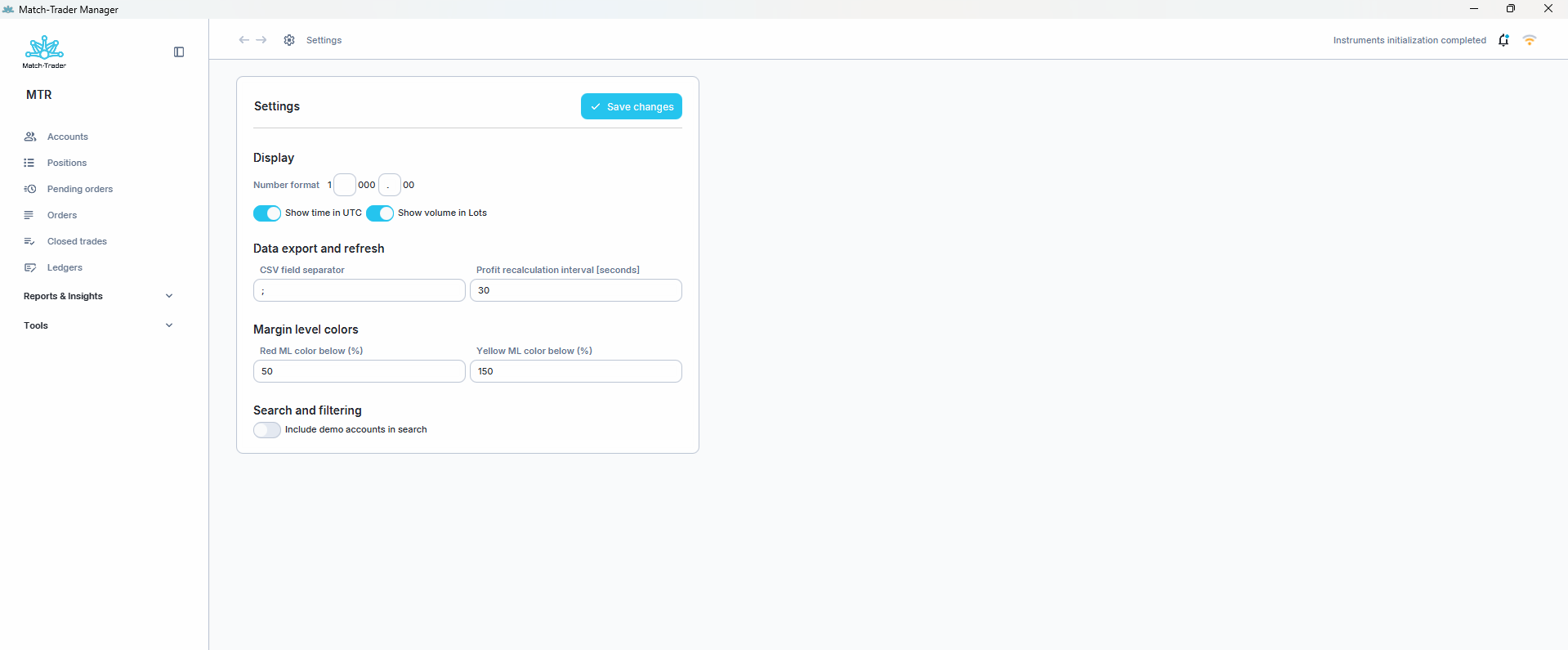
- Display:
- Number format – the thousands separator and the decimal separator used for numbers.
- Show time in UTC – shows all times in UTC instead of the time zone of your computer.
- Show volume in Lots – shows volumes in lots instead of units.
- Data export and refresh:
- CSV field separator – the character that separates the fields in exported CSV files, for example a semicolon.
- Profit recalculation interval [seconds] – how often the profit on open positions is recalculated. A longer interval puts less load on your computer.
- Margin level colors:
- Red ML color below (%) – margin levels below this value are shown in red.
- Yellow ML color below (%) – margin levels below this value are shown in yellow. Higher margin levels are shown in green.
- Search and filtering:
- Include demo accounts in search – when switched on, Demo accounts is ticked by default when you search for and load data.